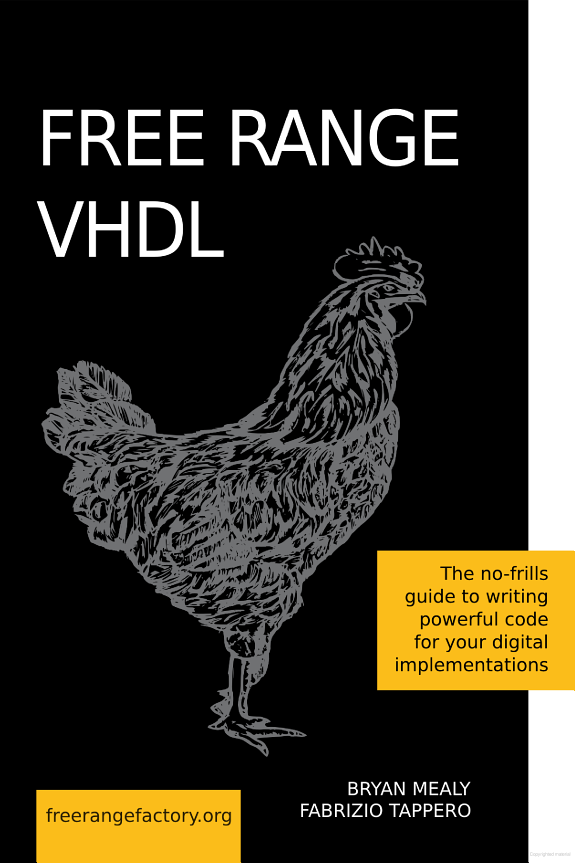
Free Range VHDL

Free Range VHDL

by Fabrizio Tappero, Bryan Mealy

158 pages· 2013· ISBN 9788497364676

Browse books you can read free on Readfeed

No club is reading this yet — be the first to start one

Start a club free
About
The purpose of this book is to provide students and engineers with a guide to help them develop the skills necessary to be able to use VHDL for introductory and intermediate level digital design. These skills will also give you the ability and the confidence to continue on with VHDL-based digital design. In this way, you will also take steps toward developing the skills required to implement more advanced digital design systems. Although there are many books and on-line tutorials dealing with VHDL, these sources are often troublesome for several reasons. Firstly, much of the information regarding VHDL is either needlessly confusing or poorly written. Material with these characteristics seems to be written from the standpoint of someone who is either painfully intelligent or has forgotten that their audience may be seeing the material for the first time. Secondly, the common approach for most VHDL manuals is to introduce too many topics and a lot of extraneous information too early. Most of this material would best appear later in the presentation. Material presented in this manner has a tendency to be confusing, is easily forgotten if misunderstood or simply is never applied. The approach taken by this book is to provide only what you need to know to quickly get up and running in VHDL. The intent of this book is to present topics to someone familiar with digital logic design and with some skills in algorithmic programming languages such as Java or C. The information presented here is focused on giving a solid knowledge of the approach and function of VHDL. With a logical and intelligent introduction to basic VHDL concepts, you should be able to quickly and efficiently create useful VHDL code. In this way, you will see VHDL as a valuable design, simulation and test tool rather than another batch of throw-away technical knowledge encountered in some forgotten class or lab. Lastly, VHDL is an extremely powerful tool. The more you understand as you study and work with VHDL, the more it will enhance your learning experience independently of your particular area of interest. It is well worth noting that VHDL and other similar hardware design languages are used to create most of the digital integrated circuits found in the various electronic gizmos that overwhelm our modern lives. The concept of using software to design hardware that is controlled by software will surely provide you with endless hours of contemplation. VHDL is a very exciting language and mastering it will allow you to implement systems capable of handling and processing in parallel ns-level logic events in a comfortable software environment. This book was written with the intention of being freely available to everybody. The formatted electronic version of this book is available from the Internet. Any part of this book can be copied, distributed and modified in accordance with the conditions of its license.

Discuss Free Range VHDL with other readers

Join or start a book club for Free Range VHDL on Readfeed. Live chat, shared reading progress, and AI discussion questions — free to get started.

Frequently asked questions

How do I join a book club for Free Range VHDL?

Sign up free on Readfeed, then browse public clubs or start your own club with Free Range VHDL as the current read. Invite friends with a share link and discuss together with live chat and AI discussion questions.

Can I discuss Free Range VHDL with other readers online?

Yes. Readfeed book clubs let you chat live, share progress, and join discussions about Free Range VHDL with readers worldwide — whether your club is virtual, in-person, or hybrid.

Is Readfeed free?

Yes. Creating an account and joining book clubs is free. Sign up to find readers who love the same books and start discussing today.