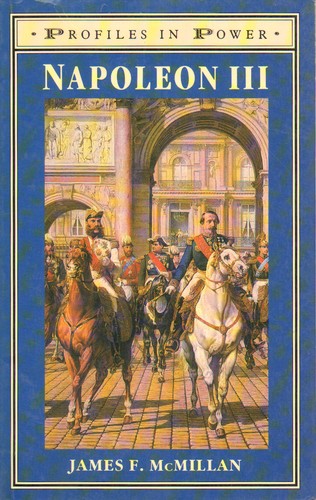
Louis Napoleon, nephew of the great Emperor, became heir to the Bonapartist legend in the early 1830s. Without wealth or party, and sustained only by ambition and a sense of destiny, he lived as an adventurer, enduring exile and imprisonment as successive coup attempts collapsed. The 1848 Revolution gave him his chance: his Bonaparte inheritance, his widely-promoted republican sympathies and, perhaps, the fact that he was better known to the French as a symbol than a person, were strong attractions to an alienated and divided people. On 20 December 1848, by a massive popular vote, he became President of France. Three turbulent years later he overturned the republican constitution, and, backed by another overwhelmingly favorable plebiscite, created the Second Empire under himself as Napoleon III. For twenty years thereafter the Second Empire revived the glories of France under the first Napoleon, with wealth and confidence at home and dazzling foreign policy that reasserted France as a prime mover in the affairs of continental Europe. But resurgent France was no match for the ambitions of resurgent Germany. The Second Empire crumbled under the defeats of the Franco-Prussian War, and Napoleon III died, as he had been raised, an exile. Napoleon III is no less enigmatic and controversial to historians as he was to contemporaries. Was he a statesman with a coherent vision or an adventurer to the end? There is no consensus on his aims and achievements. Some continue to see him in the light of the "black legend" fashioned by outraged nineteenth-century republicans; others have seen him as a precursor of Hitler and Mussolini; more recently he has been reinvented as an architect of European unity, and a pioneer of Gaullist-style technocracy. In this welcome addition to Profiles in Power James McMillan throws light on these matters from a different angle. He moves away from ideologically-inspired interpretation to study the uses Napoleon made of his imperial power. He recognizes the emperor as a skilled political operator who, despite innumerable obstacles, attempted to conduct an original policy. His central theme, however, is the irony of power: for Napoleon discovered to his cost that he could rarely achieve his goals, at home or abroad, and that his actions too often had consequences that he neither intended nor desired. - Back cover.