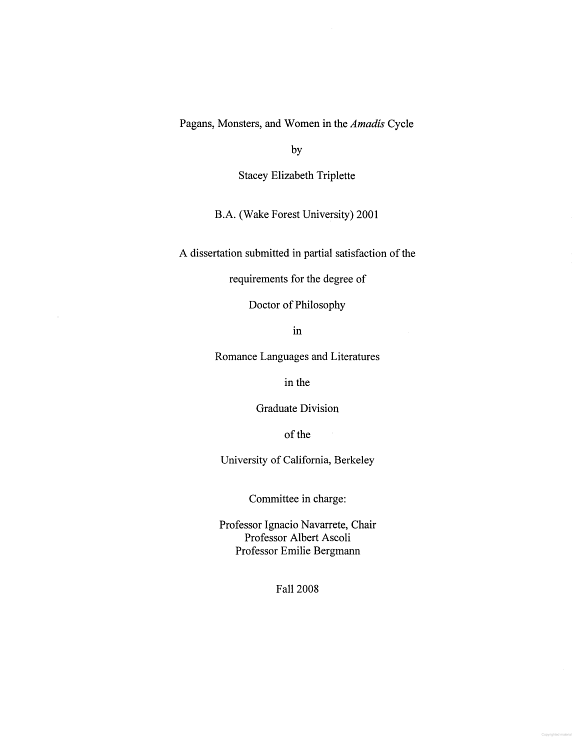
Pagans, Monsters, and Women in the "Amadis" Cycle

Pagans, Monsters, and Women in the "Amadis" Cycle

285 pages· 2008· ISBN 9781109097221
About
This dissertation focuses on theorizations of community and representations of marginality in the Spanish romances of chivalry. Garci Rodriguez de Montalvo and Feliciano de Silva, the authors under investigation, both use characters that lie outside the norm to comment on the formation of heterogeneous communities. Each of the first three chapters chronicles the fate of one of the traditional enemies of chivalric romance, respectively, giants, pagans, and Amazons. The Amadis cycle works to tame these outsiders and to incorporate them into chivalric society through conversion. The overarching plot of the series is also the story of the development of the historical Spanish Empire, and the chivalric world mirrors the Spain of Ferdinand and Isabella in important ways. The interactions between Christian and pagan serve as benchmarks in the development of the Amadis' imaginary Christian state from isolated medieval kingdom to modern nation-state to trans-Mediterranean empire. The giants, pagans, and women in the romances take the place of historical Jews and Muslims in the Iberian Peninsula, and their successful assimilation into Christian society critiques the historical discourse of pureza de sangre. Both Montalvo and de Silva question the restrictive social practices of the late fifteenth and early sixteenth centuries. Conversions in these works occur through friendship and admiration rather than force, and new Christians become full participants in the social order. The Iberian romance of chivalry articulates a Utopian vision of Empire in which the enemies of Christianity demand---and receive---respect and equitable treatment. The final chapter of the dissertation takes the argument one step further and allows these discourses about identity to reflect back on the privileged Christian knight. By focusing on a Christian knight who disguises himself as an Amazon for several years, to the point of insisting that his female, pagan identity is the true one, Feliciano de Silva draws into question the categories that allow readers to distinguish friend from foe. De Silva transforms the chivalric world into a ludic, fluid space in which genre convention can be questioned or overturned.

Discuss Pagans, Monsters, and Women in the "Amadis" Cycle with other readers

Join or start a book club for Pagans, Monsters, and Women in the "Amadis" Cycle on Readfeed. Live chat, shared reading progress, and AI discussion questions — free to get started.

Frequently asked questions

How do I join a book club for Pagans, Monsters, and Women in the "Amadis" Cycle?

Sign up free on Readfeed, then browse public clubs or start your own club with Pagans, Monsters, and Women in the "Amadis" Cycle as the current read. Invite friends with a share link and discuss together with live chat and AI discussion questions.

Can I discuss Pagans, Monsters, and Women in the "Amadis" Cycle with other readers online?

Yes. Readfeed book clubs let you chat live, share progress, and join discussions about Pagans, Monsters, and Women in the "Amadis" Cycle with readers worldwide — whether your club is virtual, in-person, or hybrid.

Is Readfeed free?

Yes. Creating an account and joining book clubs is free. Sign up to find readers who love the same books and start discussing today.