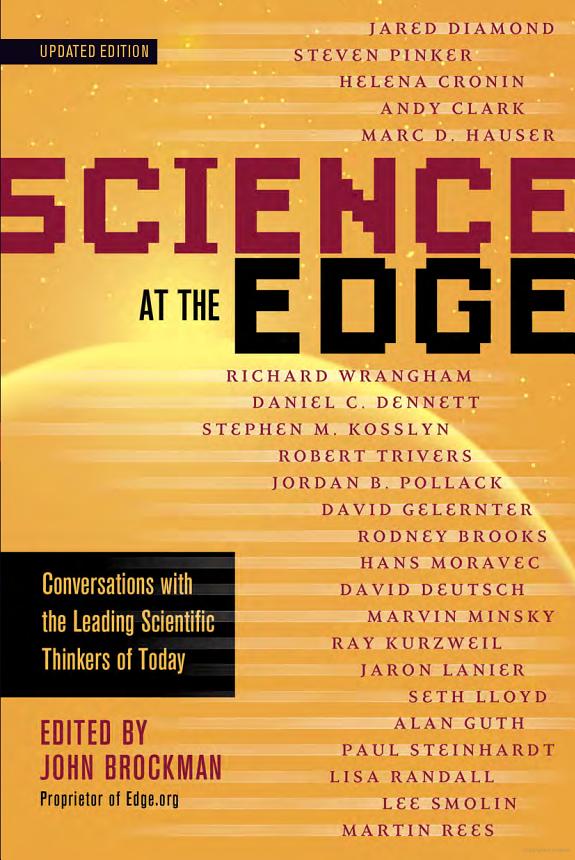
&&LDIV&&R&&LDIV&&R&&LDIV&&R&&LDIV&&R&&LP style=MARGIN: 0in 0in 0pt&&RAs founder, editor, and publisher of the intellectual forum www.edge.org, John Brockman is well-positioned to initiate and cultivate an ongoing dialogue with today's leading cutting-edge thinkers. The website is a virtual salon for every type of intellectual and scientific pursuit, from evolutionary biology and quantum physics, to crowd psychology and miniaturized computing. Through this vibrant and varied online community, Brockman has shifted sharply away from the stereotype of the introverted, out-of-touch scientist and introduced the reality of a fully aware and involved scientific society.&&L/P&&R&&LP style=MARGIN: 0in 0in 0pt&&R&&LI&&RScience at the Edge&&L/I&&R reflects this brave new world, and Brockman has assembled some of the today's most revolutionary scholars from all scientific disciplines to discuss their unique contributions to the development of modern thought. Far from being a catalog of the marginal disputes of a quarrelsome scientific class, this is a thrilling and intellectually stimulating discussion that serves as an introduction to some of the best minds of the 21st century. This revised and updated version features additional conversations, as well as a new introduction written especially for this edition.&&L/P&&R&&LP style=MARGIN: 0in 0in 0pt; TEXT-INDENT: 0.5in&&R &&L/P&&R&&LP style=MARGIN: 0in 0in 0pt&&RThe book contains Brockman's discussions, many with bestselling authors, on the following topics: &&L/P&&RPopulation theory, with Pulitzer Prize-winning author Jared Diamond Human nature, with Steven Pinker, author of &&LI&&RThe Stuff Of Thought&&L/I&&R Technology and the human mind, with Ray Kurzweil, author of the controversial book &&LI&&RThe Age of Spiritual Machines&&L/I&&R Ways for humans to make themselves more intelligent, with Marvin Minsky, author of &&LI&&RThe Emotion Machine&&L/I&&R Evolution of mankind's violence, with Richard Wrangham, co-author of &&LI&&RDemonic Males: Apes and the Origins of Human Violence&&L/I&&R Possibilities of robot life, with Rodney Brooks, author of &&LI&&RFlesh and Machines: How Robots Will Change Us&&L/I&&R Cognitive science and brain development, with Marc Hauser, author of &&LI&&RThe Evolution of Communication&&L/I&&R String theory and dimensions of space, with Lisa Randall, Harvard physics professor&&LP style=MARGIN: 0in 0in 0pt; mso-list: l0 level1 lfo1; tab-stops: list .5in&&RA selection of the Scientific American Book Club.&&L/P&&R&&L/DIV&&R&&L/DIV&&R&&L/DIV&&R&&L/DIV&&R