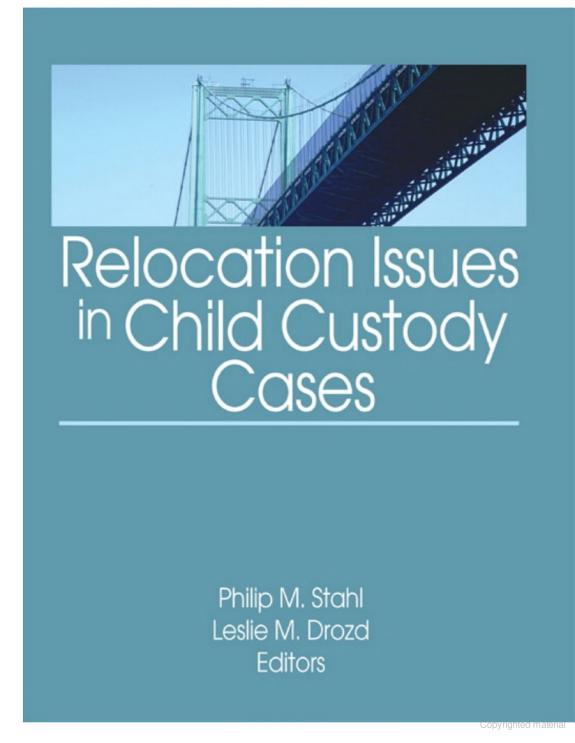
Relocation Issues in Child Custody Cases

Relocation Issues in Child Custody Cases

by Philip M. Stahl, Leslie M. Drozd

198 pages· 2013· ISBN 9781136456312

Browse books you can read free on Readfeed

No club is reading this yet — be the first to start one

Start a club free
About
Find out how evaluators, mediators, and judges deal with the issues of relocation in divorced families In the past, the relocation of a parent or child in custody cases was rarely a problem for divorced families—there was little conflict and little need for court intervention. But with the growth of shared custody, more fathers involved in parenting after divorce, and an increase in litigation between conflicted parents, relocation has become a complex issue that’s difficult for evaluators, judges, and public policymakers to resolve. Relocation Issues in Child Custody Cases offers a firsthand look at how evaluators investigate, predict, and make recommendations; how judges reach decisions based on those recommendations; and how individual states deal with relocation cases. Relocation Issues in Child Custody Cases examines how evaluators, mediators, and judges can best facilitate an environment where a child has an ongoing relationship with two parents, regardless of where each parent lives. This unique book looks at how the landscape in relocation cases has changed since the California Supreme Court’s landmark 2004 ruling in the LaMusga move-away case, examining relevant topics, including individual state statutes on relocation; a survey of courts in the United States; the functions of an evaluator; how a judge analyzes data before reaching a decision; parental conflict; domestic violence; change of circumstances; primary residence; and the process of developing parenting plans. Relocation Issues in Child Custody Cases examines: whether negative outcomes of parental relocation after divorce were a result of pre-existing conflict and domestic violence whether the “best interests of the child” is an acceptable standard in relocation cases investigative models for evaluators “for the move” and “against the move” biases—and how to reduce them a format for analyzing evidence in relocation cases the risks and benefits of presumptions in family law matters and much more Relocation Issues in Child Custody Cases is an essential resource for evaluators, mediators, judges, caseworkers, child psychologists, family therapists, and child advocates.

Discuss Relocation Issues in Child Custody Cases with other readers

Join or start a book club for Relocation Issues in Child Custody Cases on Readfeed. Live chat, shared reading progress, and AI discussion questions — free to get started.

Frequently asked questions

How do I join a book club for Relocation Issues in Child Custody Cases?

Sign up free on Readfeed, then browse public clubs or start your own club with Relocation Issues in Child Custody Cases as the current read. Invite friends with a share link and discuss together with live chat and AI discussion questions.

Can I discuss Relocation Issues in Child Custody Cases with other readers online?

Yes. Readfeed book clubs let you chat live, share progress, and join discussions about Relocation Issues in Child Custody Cases with readers worldwide — whether your club is virtual, in-person, or hybrid.

Is Readfeed free?

Yes. Creating an account and joining book clubs is free. Sign up to find readers who love the same books and start discussing today.