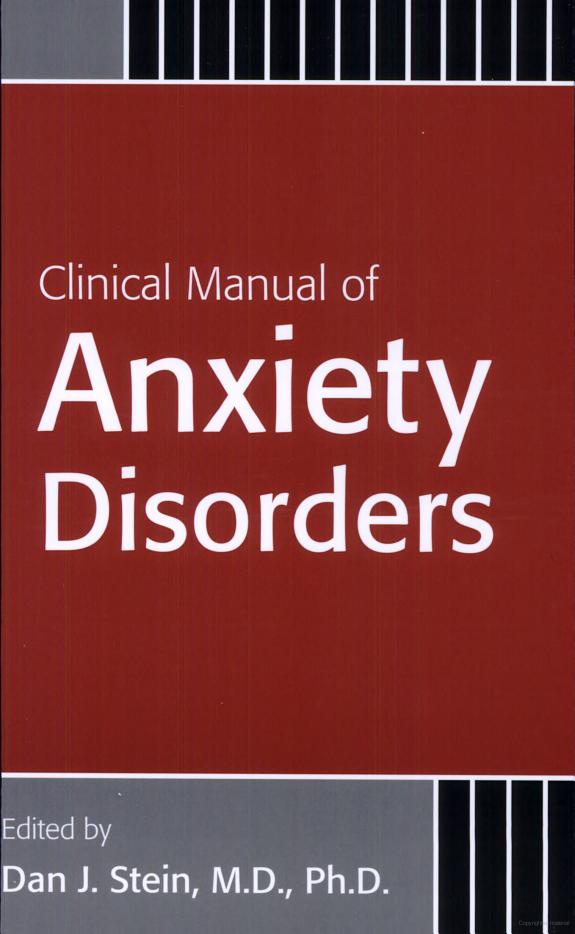
Clinical Manual of Anxiety Disorders
by Dan J. Stein
200 pages· 2007· ISBN 9781585627202
About
Anxiety disorders are among the most prevalent, persistent, disabling, and costly psychiatric disorders, yet they are often underdiagnosed and undertreated. Fortunately, there have been major advances in understanding and treating these conditions in recent years; this is one of the most exciting areas in modern medicine. This clinical manual has earned its place in the literature as one of just a few volumes that covers all of the major anxiety disorders and presents integrated contributions from both psychopharmacologists and psychotherapists -- all in one compact work written for busy clinicians. Though concepts of anxiety have long enjoyed a central position in philosophical and psychoanalytic theories, empirical research on anxiety disorders has a relatively short history. Here, 16 experts discuss advances in diagnosis, assessment (including relevant rating scales), pharmacotherapy, and psychotherapy. This volume begins by reviewing recent important diagnostic, epidemiological, neurobiological, and treatment findings -- all of which have significant implications for clinicians. Subsequent chapters cover Panic disorder and agoraphobia -- Laboratory studies of fear have significantly advanced our understanding of the neurocircuitry and neurochemistry of panic. Furthermore, panic disorder is now readily treated with both medications and psychotherapy. Specific phobia -- Viewed for many years as mild and even trivial, this common disorder is now recognized for its very real associated distress and impairment. Exposure therapy is the treatment mainstay, though pharmacotherapy should be considered particularly when there is comorbidity. Social phobia (or social anxiety disorder) -- In the past few years, the first FDA-approved medications for this disorder have been made available. Cognitive-behavioral therapy is also effective for the treatment of this underdiagnosed and undertreated condition. Obsessive-compulsive disorder (OCD) -- OCD was the first disorder where it was shown that both specific medications and cognitive-behavioral techniques resulted in normalization of activity in particular brain structures. It is now possible to provide patients with integrated treatment approaches. Posttraumatic stress disorder (PTSD) -- Once viewed as a normal reaction to trauma, PTSD is increasingly understood as a pathological response, characterized by specific psychobiological dysfunctions. Again, there have been exciting advances in the treatment of this disorder, with the release of the first FDA-approved agents for PTSD. Generalized anxiety disorder (GAD) -- For a number of years GAD was thought of as a residual disorder occasionally seen in combination with more primary conditions. Nowadays, we know that GAD is an independent condition that is prevalent, persistent, and disabling. Busy residents and psychiatrists in active clinical practice, psychologists, primary care practitioners, and other mental health professionals will find this clinical manual -- with its integrated approach of both pharmacotherapy and psychotherapy -- a valuable tool in their everyday practices.
Discuss Clinical Manual of Anxiety Disorders with other readers
Join or start a book club for Clinical Manual of Anxiety Disorders on Readfeed. Live chat, shared reading progress, and AI discussion questions — free to get started.
Frequently asked questions
How do I join a book club for Clinical Manual of Anxiety Disorders?
Sign up free on Readfeed, then browse public clubs or start your own club with Clinical Manual of Anxiety Disorders as the current read. Invite friends with a share link and discuss together with live chat and AI discussion questions.
Can I discuss Clinical Manual of Anxiety Disorders with other readers online?
Yes. Readfeed book clubs let you chat live, share progress, and join discussions about Clinical Manual of Anxiety Disorders with readers worldwide — whether your club is virtual, in-person, or hybrid.
Is Readfeed free?
Yes. Creating an account and joining book clubs is free. Sign up to find readers who love the same books and start discussing today.