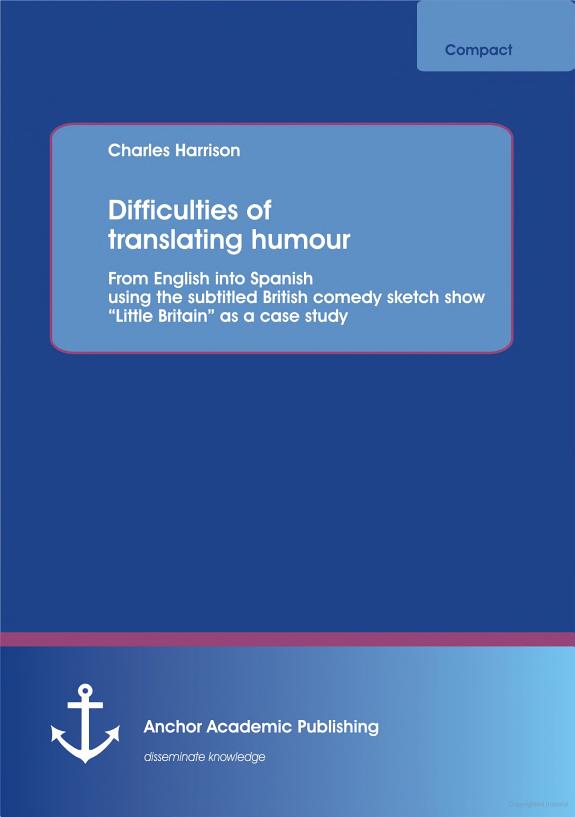
Difficulties of Translating Humour: From English Into Spanish Using the Subtitled British Comedy Sketch Show "Little Britain" as a Case Study

Difficulties of Translating Humour: From English Into Spanish Using the Subtitled British Comedy Sketch Show "Little Britain" as a Case Study

by Charles Harrison

52 pages· 2013· ISBN 9783954890286

Browse books you can read free on Readfeed

No club is reading this yet — be the first to start one

Start a club free
About
Humour is a complex concept which tends to build on the ambiguity of language. When converting a humoristic program into a different language, the translator thus faces many challenges. One of these is the translation of cultural aspects of the TL (target language). Since every culture contains its unique form of humour, understanding the humour within a culture and all its cultural elements is essential to producing an adequate translation. The study at hand focuses on the translation of the British comedy-sketch show Little Britain analyzing how it has been converted from its SL (source language), which is English, to its TL, which in this study will be Spanish. It proved to be highly constructive for the purposes of this research as the humour is often very culture-specific and thus difficult to translate. For the benefit of the reader, the first part of this dissertation is going to discuss various theories of humour. Moreover, it will discuss how humour is created in the comedy sketch show Little Britain. As subtitles will be used for the analysis of the case study, limitations and constraints will be discussed as the translator cannot merely focus on the linguistic features and possible problems like she/he would do in any other form of translation. Using Attardo's theory (1994), the study aims to explore aspects that create difficulties during the translation process, always in relation to humour that is seen in a comedy sketch show. It explores the translation of humour, examining potential problems that translators need to overcome and expands on this by investigating the difficulties that arise when translating culture-specific issues. In addition, as this is an audiovisual translation, potential problems that become relevant in the case study are highlighted. The study highlights the difficulties a translator faces within the process and, where relevant, possible alternative strategies that the translator could have applied in the translation process.

Discuss Difficulties of Translating Humour: From English Into Spanish Using the Subtitled British Comedy Sketch Show "Little Britain" as a Case Study with other readers

Join or start a book club for Difficulties of Translating Humour: From English Into Spanish Using the Subtitled British Comedy Sketch Show "Little Britain" as a Case Study on Readfeed. Live chat, shared reading progress, and AI discussion questions — free to get started.

Frequently asked questions

How do I join a book club for Difficulties of Translating Humour: From English Into Spanish Using the Subtitled British Comedy Sketch Show "Little Britain" as a Case Study?

Sign up free on Readfeed, then browse public clubs or start your own club with Difficulties of Translating Humour: From English Into Spanish Using the Subtitled British Comedy Sketch Show "Little Britain" as a Case Study as the current read. Invite friends with a share link and discuss together with live chat and AI discussion questions.

Can I discuss Difficulties of Translating Humour: From English Into Spanish Using the Subtitled British Comedy Sketch Show "Little Britain" as a Case Study with other readers online?

Yes. Readfeed book clubs let you chat live, share progress, and join discussions about Difficulties of Translating Humour: From English Into Spanish Using the Subtitled British Comedy Sketch Show "Little Britain" as a Case Study with readers worldwide — whether your club is virtual, in-person, or hybrid.

Is Readfeed free?

Yes. Creating an account and joining book clubs is free. Sign up to find readers who love the same books and start discussing today.