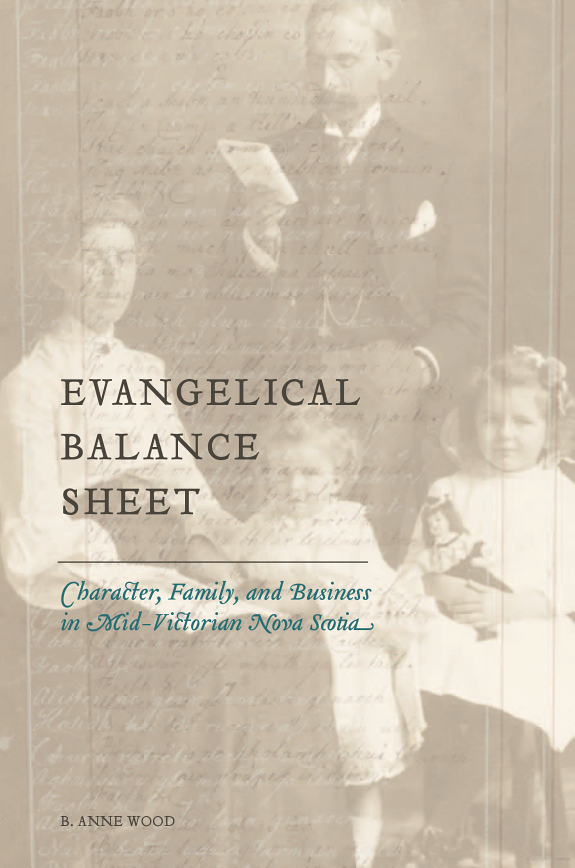
Evangelical Balance Sheet

Evangelical Balance Sheet

Character, Family, and Business in Mid-Victorian Nova Scotia

by B. Anne Wood

228 pages· 2010· ISBN 9781554588237

Browse books you can read free on Readfeed

No club is reading this yet — be the first to start one

Start a club free
About
Using the journals of W. Norman Rudolf (1835-1886), a Victorian merchant, Evangelical Balance Sheet: Character, Family, and Business in Mid-Victorian Nova Scotia explores the important role of character ideals and evangelicalism in mid-Victorian culture. Rudolf’s diary, with its daily weather observations, its account of family matters, of social and business happenings, and of his own experiences, as well as occasional literary or naturalistic forays, attempts to follow a disciplined regime of writing, but also has elements of a Bildungsroman. The diary reveals an obvious and significant tension between his inner, spiritual search for meaning in his life (evangelical inwardness) and his outward stewardship duties. Rudolf’s concept of character, then, involved a type of balance sheet of his evangelical service record, to his God, his family, his business, and his community. Needing God’s help to transform his will and to interpret the world in a constructive, rational manner, the underlying intent of his daily journal writing was to keep his commitment to an ethic of benevolence and of the affirmation of the goodness of human beings. Wood elucidates the cultivation of civic-minded masculinity in the context of Victorian Maritime Canada, analyzing the multiple facets of the character ideal and emphasizing its important role in Victorians’ understanding of their life experiences. In the process Wood reveals many underlying assumptions about social change and about civic discourse. The book also describes how the tremendous economic upheavals experienced by many entrepreneurs in the late 1860s to 1880s tempered their evangelical zeal and made it increasingly difficult for them to achieve a balanced and humane perspective on their own lives. Evangelical Balance Sheet will appeal to a broad audience interested in social history, imperial studies, gender studies (especially changing ideas of masculinity and manhood), Atlantic Canada studies, and local history of the Pictou region.

Discuss Evangelical Balance Sheet with other readers

Join or start a book club for Evangelical Balance Sheet on Readfeed. Live chat, shared reading progress, and AI discussion questions — free to get started.

Frequently asked questions

How do I join a book club for Evangelical Balance Sheet?

Sign up free on Readfeed, then browse public clubs or start your own club with Evangelical Balance Sheet as the current read. Invite friends with a share link and discuss together with live chat and AI discussion questions.

Can I discuss Evangelical Balance Sheet with other readers online?

Yes. Readfeed book clubs let you chat live, share progress, and join discussions about Evangelical Balance Sheet with readers worldwide — whether your club is virtual, in-person, or hybrid.

Is Readfeed free?

Yes. Creating an account and joining book clubs is free. Sign up to find readers who love the same books and start discussing today.