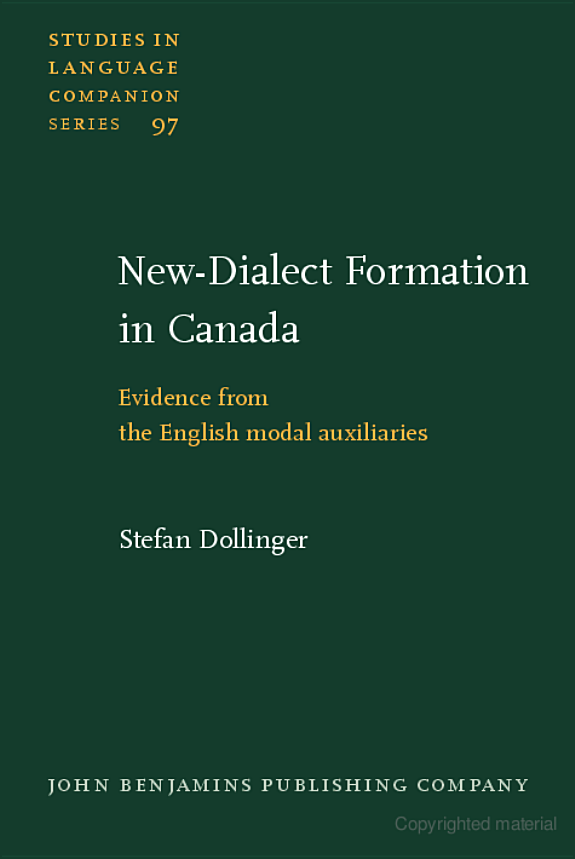
New-dialect Formation in Canada

New-dialect Formation in Canada

Evidence from the English Modal Auxiliaries

by Stefan Dollinger

355 pages· 2008· ISBN 9789027231086

Browse books you can read free on Readfeed

About
This book details the development of eleven modal auxiliaries in late 18th- and 19th-century Canadian English in a framework of new-dialect formation. The study assesses features of the modal auxiliaries, tracing influences to British and American input varieties, parallel developments, or Canadian innovations. The findings are based on the "Corpus of Early Ontario English," "pre-Confederation Section, "the first electronic corpus of early Canadian English. The data, which are drawn from newspapers, diaries and letters, include original transcriptions from manuscript sources and texts from semi-literate writers. While the overall results are generally coherent with new-dialect formation theory, the Ontarian context suggests a number of adaptations to the current model. In addition to its general Late Modern English focus, "New-Dialect Formation in Canada" traces changes in epistemic modal functions up to the present day, offering answers to the loss of root uses in the central modals. By comparing Canadian with British and American data, important theoretical insights on the origins of the variety are gained. The study offers a sociohistorical perspective on a still understudied variety of North American English by combining language-internal features with settlement history in this first monograph-length, diachronic treatment of Canadian English in real time.

Discuss New-dialect Formation in Canada with other readers

Join or start a book club for New-dialect Formation in Canada on Readfeed. Live chat, shared reading progress, and AI discussion questions — free to get started.

Frequently asked questions

How do I join a book club for New-dialect Formation in Canada?

Sign up free on Readfeed, then browse public clubs or start your own club with New-dialect Formation in Canada as the current read. Invite friends with a share link and discuss together with live chat and AI discussion questions.

Can I discuss New-dialect Formation in Canada with other readers online?

Yes. Readfeed book clubs let you chat live, share progress, and join discussions about New-dialect Formation in Canada with readers worldwide — whether your club is virtual, in-person, or hybrid.

Is Readfeed free?

Yes. Creating an account and joining book clubs is free. Sign up to find readers who love the same books and start discussing today.