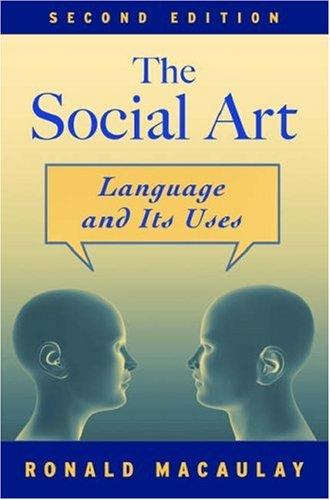
"From a baby's first words to the great works of literature, language plays an integral part in our lives. Yet most of us know very little about the nature of language - what it is, how we learn it, how it works. Indeed, though linguists, philosophers, psychologists, and other thinkers have made great strides in the understanding of language, little of their insight has trickled down to the general public. To remedy this, Ronald Macaulay provides in The Social Art an informative, intriguing tour of what we know about language today, in thirty brief, highly readable chapters replete with jokes, anecdotes, and vivid examples." "Macaulay offers a sweeping look at language in all its aspects. Ranging far and wide, he delves into such topics as child language acquisition, syntax, semantics, writing, style, conversation, swearing, rhetoric, narrative, literature, and the history of English. Each chapter provides an authoritative overview of a particular topic - from Pidgins and Creoles to the Magic of Words - spiced with intriguing asides. In his discussion of conversation, for instance, Macaulay points out that while many cultures abhor silence in the company of others, among the Western Apache it is normal to greet strangers with silence (talking begins only when the participants feel at ease with each other). Likewise, in the chapter on the history of English, we learn that many English terms relating to finance - including "capital," "fee," "chattel," and "pecuniary" - all come from words relating to domestic herds, dating back to societies where one's wealth was measured in the number of cows one owned." "The book also includes many fascinating nuggets about languages world-wide. We read of click languages such as Hottentot, Zulu, and Xhosa, where some consonant sounds are produced by sucking in air to produce clicking sounds (because of the difficulty in producing sequences of these sounds, Zulu-speaking children practice saying tongue-twisters with numerous clicks). And we sample amusing coinages from Tok Pisin (a pidgin language derived from English): for instance, gras means "grass"; gras bilong fes means "beard"; gras bilong hed means "hair"; and gras bilong pisin means "feather." And finally, Macaulay raises many provocative questions concerning language. For instance, is the elite version of any language intrinsically better than its dialects, or is it simply (as Max Weinreich put it) "a dialect with an army"? Is there any conclusive evidence that girls develop language skills earlier than boys? (Macaulay says no.) And is it true that the way people perceive the world is determined by the language they speak, that as Wittgenstein claimed, "the limits of my language are the limits of my world"?" "Thoughtful, informative, delightful, this volume is the perfect overview of an art we all practice every day of our lives. An excellent starting point for anyone interested in language, linguistics, or writing, it will give readers a new appreciation of the pleasure to be found in the study of this uniquely human phenomenon."--BOOK JACKET.