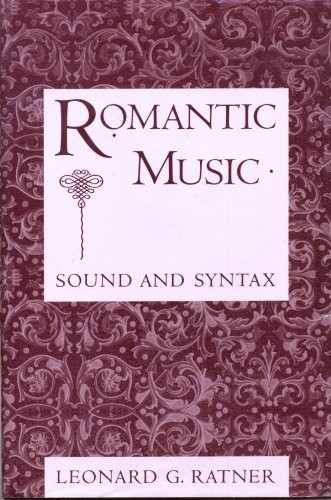
Profound changes took place in musical sound throughout the nineteenth century. An expanded range of sound in many instruments - including the piano - a new richness of timbre, and a variety of expressive sound effects opened new options for composers. Many, such as Hector Berlioz and Gustav Mahler, used the possibilities of new sounds as a strategy of composition, regarding innovative sounds as important values in their own right. For listeners, too, colorful sound was an immediate clue to the expressive content of a composition. Pushing against the perimeters of Classic syntax to form new Romantic musical styles, composers simultaneously retained the entire traditional apparatus of Classic music, including melodic construction, phrase and period structures, and harmonic progressions, while adding to it a new quality of sound that enriched the traditional possibilities of the music.^
Romantic Music: Sound and Syntax is the first study to examine the role played by qualities of sound in shaping Romantic musical form. By demonstrating the crucial interaction of sound and syntax in Romantic music, Leonard G. Ratner demonstrates the effectiveness of a new theoretical approach to musical analysis, incorporating sound as an analytical factor for the first time. The book is divided into 13 chapters. Chapter 1 surveys critical comments dealing with qualities of sound in the nineteenth century. Chapter 2 examines the continuity between Classic and Romantic texture and sound. Specific examples drawn from piano, orchestral, and chamber music literature are discussed in chapters 3-5. Chapter 6 explores the uses of harmonic color in the Romantic repertoire. Chapter 7 reviews the tradition of the period form in Western music and its continuity in Romantic music.^
Chapter 8 discusses rhetorical reduction, a technique that factors out the changes introduced by the new sound values to uncover the conventional outlines of the music. Chapter 9 examines symmetrical arrangements in the music of Johannes Brahms, Giuseppe Verdi, Felix Mendelssohn, and Robert Schumann. Chapter 10 discusses the modification of symmetry by sustained sounds and harmonic progressions in the music of Carl Maria von Weber, Franz Schubert, Frederic Chopin, and Richard Wagner. Chapter 11 explores the extensions of periodic symmetry in the music of Hector Berlioz, Gustav Mahler, Franz Liszt, Brahms, and Wagner. The last two chapters treat small forms and sonata forms in the music of Mendelssohn, Brahms, Liszt, and Mahler.