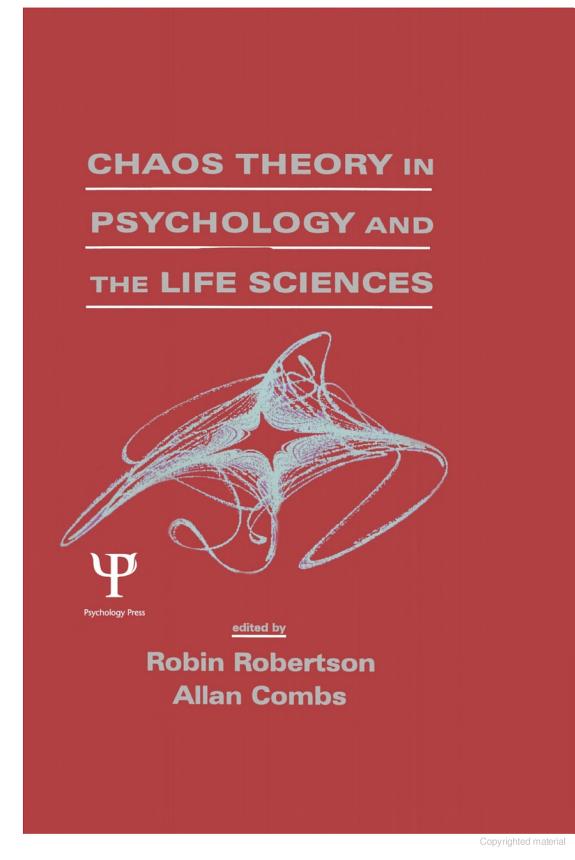
Chaos theory in Psychology and the Life Sciences

Chaos theory in Psychology and the Life Sciences

by Robin Robertson, Allan Combs

416 pages· 2014· ISBN 9781317780076
About
This book represents the best of the first three years of the Society for Chaos Theory in Psychology conferences. While chaos theory has been a topic of considerable interest in the physical and biological sciences, its applications in psychology and related fields have been obscured until recently by its complexity. Nevertheless, a small but rapidly growing community of psychologists, neurobiologists, sociologists, mathematicians, and philosophers have been coming together to discuss its implications and explore its research possibilities. Chaos theory has been termed the first authentic paradigm shift since the advent of quantum physics. Whether this is true or not, it unquestionably bears profound implications for many fields of thought. These include the cognitive analysis of the mind, the nature of personality, the dynamics of psychotherapy and counseling, understanding brain events and behavioral records, the dynamics of social organization, and the psychology of prediction. To each of these topics, chaos theory brings the perspective of dynamic self-organizing processes of exquisite complexity. Behavior, the nervous system, and social processes exhibit many of the classical characteristics of chaotic systems -- they are deterministic and globally predictable and yet do not submit to precise predictability. This volume is the first to explore ideas from chaos theory in a broad, psychological perspective. Its introduction, by the prominent neuroscientist Walter Freeman, sets the tone for diverse discussions of the role of chaos theory in behavioral research, the study of personality, psychotherapy and counseling, mathematical cognitive psychology, social organization, systems philosophy, and the understanding of the brain.

Discuss Chaos theory in Psychology and the Life Sciences with other readers

Join or start a book club for Chaos theory in Psychology and the Life Sciences on Readfeed. Live chat, shared reading progress, and AI discussion questions — free to get started.

Frequently asked questions

How do I join a book club for Chaos theory in Psychology and the Life Sciences?

Sign up free on Readfeed, then browse public clubs or start your own club with Chaos theory in Psychology and the Life Sciences as the current read. Invite friends with a share link and discuss together with live chat and AI discussion questions.

Can I discuss Chaos theory in Psychology and the Life Sciences with other readers online?

Yes. Readfeed book clubs let you chat live, share progress, and join discussions about Chaos theory in Psychology and the Life Sciences with readers worldwide — whether your club is virtual, in-person, or hybrid.

Is Readfeed free?

Yes. Creating an account and joining book clubs is free. Sign up to find readers who love the same books and start discussing today.