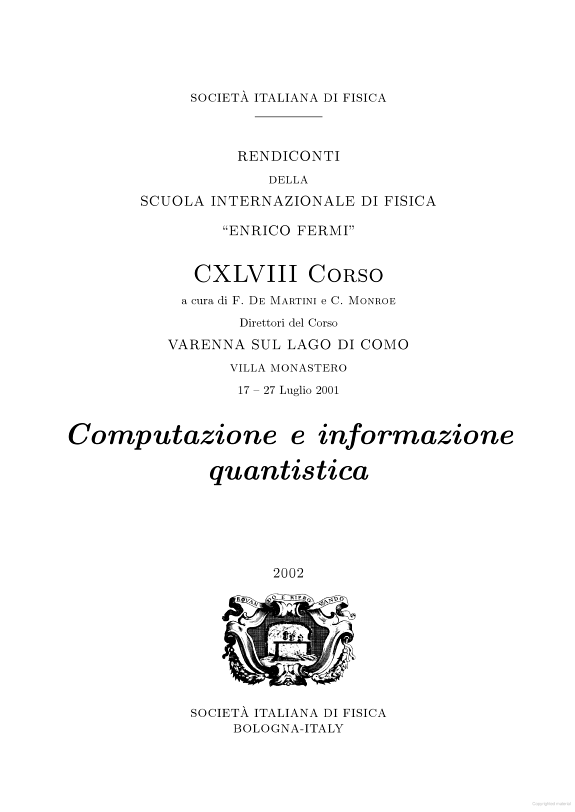
Experimental Quantum Computation and Information

Experimental Quantum Computation and Information

by F. de Martini, C. Monroe

570 pages· 2003· ISBN 9781614990048

Browse books you can read free on Readfeed

No club is reading this yet — be the first to start one

Start a club free
About
This Fermi Summer School of Physics on "Experimental Quantum Information and Computing" represents a primer on one of the most intriguing and rapidly expanding new areas of physics. In this part, the interest in quantum information (QI) science is due to the discovery that a computer operating on quantum mechanical principles can solve certain important computational problems exponentially faster than any conceivable classical computer. But this interest is also due to the interdisciplinary nature of the field: the rapid growth is attributable, in part, to the stimulating confluence of researchers and ideas from physics, chemistry, mathematics, information theory, and computer science. Physics plays a paramount role in QI science, as we realize that computing is itself a physical process subject to physical laws. The incredible growth of classical computers and information processors in the 20th century stems from Turing's notion that a computer is independent of the physical device actually being used; be they relays, vacuum tubes, or semiconductor transistors. As we strive to build useful quantum information processors into the 21st century, we thus look for any physical system that obeys the laws of quantum mechanics, from single photons and atoms to quantum superconducting devices. These Fermi lectures take us on a journey through these and other promising current experimental candidates for QI processing, spanning quantum optics and laser physics, atomic and molecular physics, physical chemistry, and condensed-matter physics. While this broad coverage of experimental physics represents a challenge to the student, such an appreciation of these fields will be critical in the future success of quantum technology. Indeed, the most exciting feature of QI science is that the technology ultimately leading to a quantum processor is likely presently unknown.

Discuss Experimental Quantum Computation and Information with other readers

Join or start a book club for Experimental Quantum Computation and Information on Readfeed. Live chat, shared reading progress, and AI discussion questions — free to get started.

Frequently asked questions

How do I join a book club for Experimental Quantum Computation and Information?

Sign up free on Readfeed, then browse public clubs or start your own club with Experimental Quantum Computation and Information as the current read. Invite friends with a share link and discuss together with live chat and AI discussion questions.

Can I discuss Experimental Quantum Computation and Information with other readers online?

Yes. Readfeed book clubs let you chat live, share progress, and join discussions about Experimental Quantum Computation and Information with readers worldwide — whether your club is virtual, in-person, or hybrid.

Is Readfeed free?

Yes. Creating an account and joining book clubs is free. Sign up to find readers who love the same books and start discussing today.