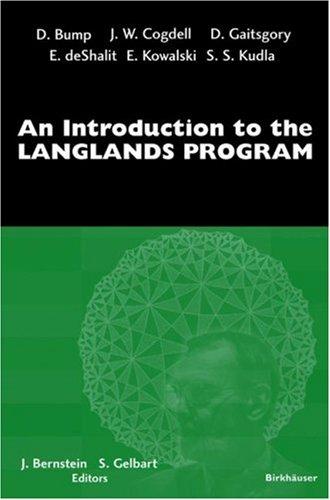
An introduction to the Langlands program

An introduction to the Langlands program

by Daniel Bump, Joseph Bernstein, Stephen S. Gelbart

Browse books you can read free on Readfeed

No club is reading this yet — be the first to start one

Start a club free
About
For the past several decades the theory of automorphic forms has become a major focal point of development in number theory and algebraic geometry, with applications in many diverse areas, including combinatorics and mathematical physics. The twelve chapters of this monograph present a broad, user-friendly introduction to the Langlands program, that is, the theory of automorphic forms and its connection with the theory of L-functions and other fields of mathematics. Key features of this self-contained presentation: A variety of areas in number theory from the classical zeta function up to the Langlands program are covered. The exposition is systematic, with each chapter focusing on a particular topic devoted to special cases of the program: • Basic zeta function of Riemann and its generalizations to Dirichlet and Hecke L-functions, class field theory and some topics on classical automorphic functions (E. Kowalski) • A study of the conjectures of Artin and Shimura–Taniyama–Weil (E. de Shalit) • An examination of classical modular (automorphic) L-functions as GL(2) functions, bringing into play the theory of representations (S.S. Kudla) • Selberg's theory of the trace formula, which is a way to study automorphic representations (D. Bump) • Discussion of cuspidal automorphic representations of GL(2,(A)) leads to Langlands theory for GL(n) and the importance of the Langlands dual group (J.W. Cogdell) • An introduction to the geometric Langlands program, a new and active area of research that permits using powerful methods of algebraic geometry to construct automorphic sheaves (D. Gaitsgory) Graduate students and researchers will benefit from this beautiful text.

Discuss An introduction to the Langlands program with other readers

Join or start a book club for An introduction to the Langlands program on Readfeed. Live chat, shared reading progress, and AI discussion questions — free to get started.

Frequently asked questions

How do I join a book club for An introduction to the Langlands program?

Sign up free on Readfeed, then browse public clubs or start your own club with An introduction to the Langlands program as the current read. Invite friends with a share link and discuss together with live chat and AI discussion questions.

Can I discuss An introduction to the Langlands program with other readers online?

Yes. Readfeed book clubs let you chat live, share progress, and join discussions about An introduction to the Langlands program with readers worldwide — whether your club is virtual, in-person, or hybrid.

Is Readfeed free?

Yes. Creating an account and joining book clubs is free. Sign up to find readers who love the same books and start discussing today.