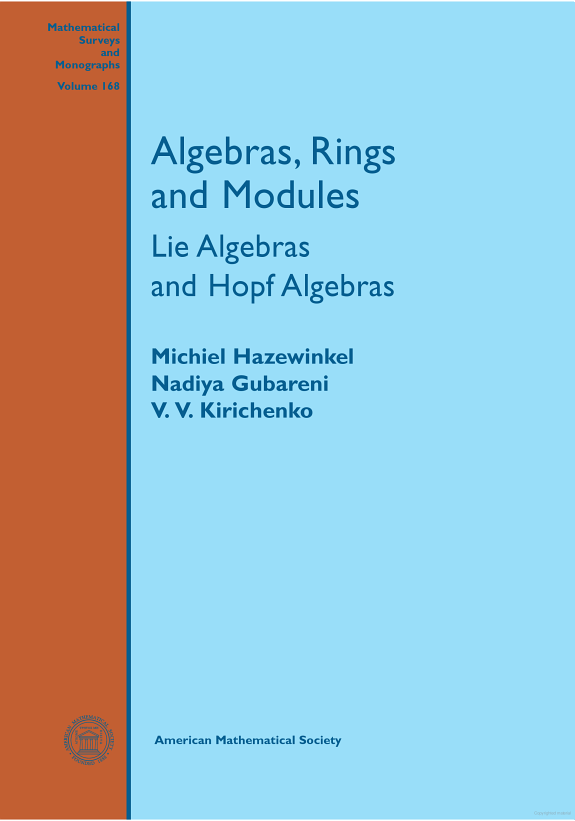
Algebras, Rings, and Modules

Algebras, Rings, and Modules

Lie Algebras and Hopf Algebras

by Michiel Hazewinkel, Nadezhda Mikhaĭlovna Gubareni, Vladimir V. Kirichenko

411 pages· 2010· ISBN 9780821852620
About
The main goal of this book is to present an introduction to and applications of the theory of Hopf algebras. The authors also discuss some important aspects of the theory of Lie algebras. The first chapter can be viewed as a primer on Lie algebras, with the main goal to explain and prove the Gabriel-Bernstein-Gelfand-Ponomarev theorem on the correspondence between the representations of Lie algebras and quivers; this material has not previously appeared in book form. The next two chapters are also ""primers"" on coalgebras and Hopf algebras, respectively; they aim specifically to give sufficient background on these topics for use in the main part of the book. Chapters 4-7 are devoted to four of the most beautiful Hopf algebras currently known: the Hopf algebra of symmetric functions, the Hopf algebra of representations of the symmetric groups (although these two are isomorphic, they are very different in the aspects they bring to the forefront), the Hopf algebras of the nonsymmetric and quasisymmetric functions (these two are dual and both generalize the previous two), and the Hopf algebra of permutations. The last chapter is a survey of applications of Hopf algebras in many varied parts of mathematics and physics. Unique features of the book include a new way to introduce Hopf algebras and coalgebras, an extensive discussion of the many universal properties of the functor of the Witt vectors, a thorough discussion of duality aspects of all the Hopf algebras mentioned, emphasis on the combinatorial aspects of Hopf algebras, and a survey of applications already mentioned. The book also contains an extensive (more than 700 entries) bibliography.|The main goal of this book is to present an introduction to and applications of the theory of Hopf algebras. The authors also discuss some important aspects of the theory of Lie algebras. The first chapter can be viewed as a primer on Lie algebras, with the main goal to explain and prove the Gabriel-Bernstein-Gelfand-Ponomarev theorem on the correspondence between the representations of Lie algebras and quivers; this material has not previously appeared in book form. The next two chapters are also ""primers"" on coalgebras and Hopf algebras, respectively; they aim specifically to give sufficient background on these topics for use in the main part of the book. Chapters 4-7 are devoted to four of the most beautiful Hopf algebras currently known: the Hopf algebra of symmetric functions, the Hopf algebra of representations of the symmetric groups (although these two are isomorphic, they are very different in the aspects they bring to the forefront), the Hopf algebras of the nonsymmetric and quasisymmetric functions (these two are dual and both generalize the previous two), and the Hopf algebra of permutations. The last chapter is a survey of applications of Hopf algebras in many varied parts of mathematics and physics. Unique features of the book include a new way to introduce Hopf algebras and coalgebras, an extensive discussion of the many universal properties of the functor of the Witt vectors, a thorough discussion of duality aspects of all the Hopf algebras mentioned, emphasis on the combinatorial aspects of Hopf algebras, and a survey of applications already mentioned. The book also contains an extensive (more than 700 entries) bibliography.

Discuss Algebras, Rings, and Modules with other readers

Join or start a book club for Algebras, Rings, and Modules on Readfeed. Live chat, shared reading progress, and AI discussion questions — free to get started.

Frequently asked questions

How do I join a book club for Algebras, Rings, and Modules?

Sign up free on Readfeed, then browse public clubs or start your own club with Algebras, Rings, and Modules as the current read. Invite friends with a share link and discuss together with live chat and AI discussion questions.

Can I discuss Algebras, Rings, and Modules with other readers online?

Yes. Readfeed book clubs let you chat live, share progress, and join discussions about Algebras, Rings, and Modules with readers worldwide — whether your club is virtual, in-person, or hybrid.

Is Readfeed free?

Yes. Creating an account and joining book clubs is free. Sign up to find readers who love the same books and start discussing today.