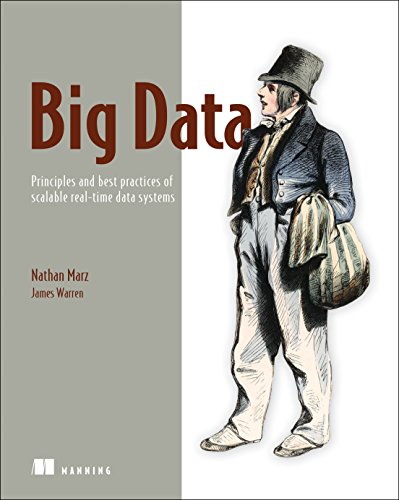
Big Data: Principles and best practices of scalable realtime data systems
by Nathan Marz, James Warren
Summary
Big Data teaches you to build big data systems using an architecture that takes advantage of clustered hardware along with new tools designed specifically to capture and analyze web-scale data. It describes a scalable, easy-to-understand approach to big data systems that can be built and run by a small team. Following a realistic example, this book guides readers through the theory of big data systems, how to implement them in practice, and how to deploy and operate them once they're built.
Purchase of the print book includes a free eBook in PDF, Kindle, and ePub formats from Manning Publications.
About the Book
Web-scale applications like social networks, real-time analytics, or e-commerce sites deal with a lot of data, whose volume and velocity exceed the limits of traditional database systems. These applications require architectures built around clusters of machines to store and process data of any size, or speed. Fortunately, scale and simplicity are not mutually exclusive.
Big Data teaches you to build big data systems using an architecture designed specifically to capture and analyze web-scale data. This book presents the Lambda Architecture, a scalable, easy-to-understand approach that can be built and run by a small team. You'll explore the theory of big data systems and how to implement them in practice. In addition to discovering a general framework for processing big data, you'll learn specific technologies like Hadoop, Storm, and NoSQL databases.
This book requires no previous exposure to large-scale data analysis or NoSQL tools. Familiarity with traditional databases is helpful.
What's Inside
- Introduction to big data systems
- Real-time processing of web-scale data
- Tools like Hadoop, Cassandra, and Storm
- Extensions to traditional database skills
About the Authors
Nathan Marz is the creator of Apache Storm and the originator of the Lambda Architecture for big data systems. James Warren is an analytics architect with a background in machine learning and scientific computing.
Table of Contents
- A new paradigm for Big Data
- Data model for Big Data
- Data model for Big Data: Illustration
- Data storage on the batch layer
- Data storage on the batch layer: Illustration
- Batch layer
- Batch layer: Illustration
- An example batch layer: Architecture and algorithms
- An example batch layer: Implementation
- Serving layer
- Serving layer: Illustration
- Realtime views
- Realtime views: Illustration
- Queuing and stream processing
- Queuing and stream processing: Illustration
- Micro-batch stream processing
- Micro-batch stream processing: Illustration
- Lambda Architecture in depth
PART 1 BATCH LAYER
PART 2 SERVING LAYER
PART 3 SPEED LAYER
Discuss Big Data: Principles and best practices of scalable realtime data systems with other readers
Join or start a book club for Big Data: Principles and best practices of scalable realtime data systems on Readfeed. Live chat, shared reading progress, and AI discussion questions — free to get started.
Frequently asked questions
How do I join a book club for Big Data: Principles and best practices of scalable realtime data systems?
Sign up free on Readfeed, then browse public clubs or start your own club with Big Data: Principles and best practices of scalable realtime data systems as the current read. Invite friends with a share link and discuss together with live chat and AI discussion questions.
Can I discuss Big Data: Principles and best practices of scalable realtime data systems with other readers online?
Yes. Readfeed book clubs let you chat live, share progress, and join discussions about Big Data: Principles and best practices of scalable realtime data systems with readers worldwide — whether your club is virtual, in-person, or hybrid.
Is Readfeed free?
Yes. Creating an account and joining book clubs is free. Sign up to find readers who love the same books and start discussing today.