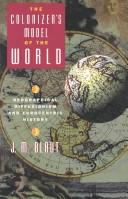
"This book challenges one of the most pervasive and powerful beliefs of our time concerning world history and world geography. This is the doctrine of European diffusionism, the belief that the rise of Europe to modernity and world dominance is due to some unique European quality of race, environment, culture, mind, or spirit, and that progress for the rest of the world results from the diffusion of European civilization. J. M. Blaut persuasively argues that this doctrine is not grounded in the facts of history and geography, but in the ideology of colonialism. It is the world model that Europeans constructed to explain, justify, and assist their colonial expansion." "The book first defines the Eurocentric diffusionist model of the world as one that invents a permanent world core, an "Inside," in which cultural evolution is natural and continuous, and a permanent periphery, an "Outside," in which cultural evolution is mainly an effect of the diffusion of ideas, commodities, settlers, and political control from the core. The ethno-history of the doctrine is traced from its 16th-century origins, through its efflorescence in the period of classical colonialism, to its present form in theories of economic development, modernization, and new world order. Blaut demonstrates that most Western scholarship is to some extent diffusionist and based implicitly in the idea that the world has one permanent center from which culture-changing ideas tend to emanate. Eurocentric diffusionism has shaped our attitudes concerning race and the environment, psychology and society, technology, and politics." "Blaut presents persuasive evidence that Europe was no more highly developed than other civilizations prior to 1492, and had no unique "potential" - intellectual, social, or environmental - for modernization. He shows that the "rise" of Europe over other world civilizations occurred because of the wealth obtained in early colonialism, mainly in the mines and slave plantations of the Americas. He then argues that the European conquest and exploitation of the Americas resulted from the fact that Europeans were geographically closer to the Americas than were African and Asian maritime-oriented civilizations, and that the conquest itself was facilitated by the great epidemics of Eastern Hemisphere diseases that decimated the populations and destroyed the civilizations of the "New World."" "This highly readable, illuminating volume will challenge and inform a broad audience that includes general readers. Disputing fundamental ideas in geography history, anthropology, and the humanities, it is essential reading for professors and students in these fields."--BOOK JACKET.