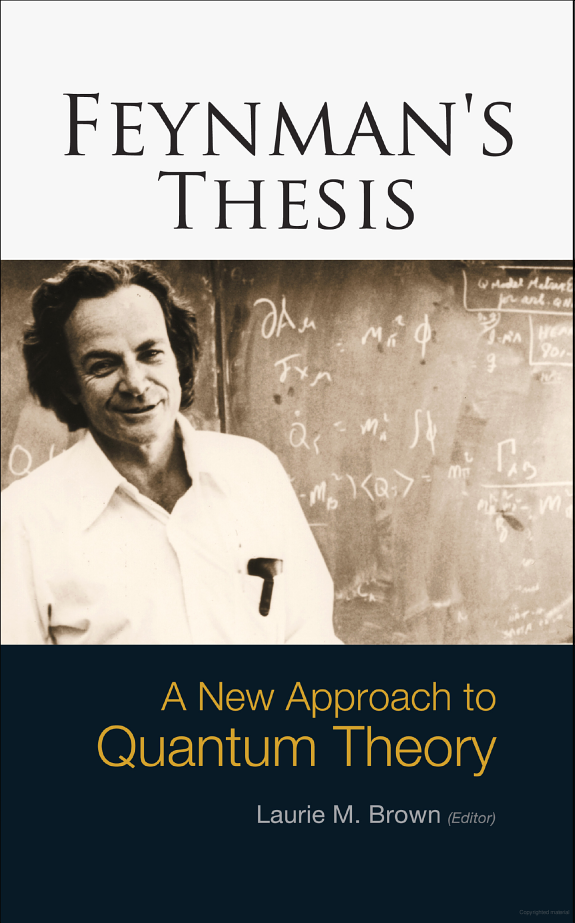
Feynman's Thesis
A New Approach to Quantum Theory
by Richard Phillips Feynman, Laurie M. Brown
119 pages· 1942· ISBN 9789812563668
Rate this book:
About
Richard Feynman's never previously published doctoral thesis formed the heart of much of his brilliant and profound work in theoretical physics. Entitled “The Principle of Least Action in Quantum Mechanics," its original motive was to quantize the classical action-at-a-distance electrodynamics. Because that theory adopted an overall space–time viewpoint, the classical Hamiltonian approach used in the conventional formulations of quantum theory could not be used, so Feynman turned to the Lagrangian function and the principle of least action as his points of departure.The result was the path integral approach, which satisfied — and transcended — its original motivation, and has enjoyed great success in renormalized quantum field theory, including the derivation of the ubiquitous Feynman diagrams for elementary particles. Path integrals have many other applications, including atomic, molecular, and nuclear scattering, statistical mechanics, quantum liquids and solids, Brownian motion, and noise theory. It also sheds new light on fundamental issues like the interpretation of quantum theory because of its new overall space–time viewpoint.The present volume includes Feynman's Princeton thesis, the related review article “Space–Time Approach to Non-Relativistic Quantum Mechanics” [Reviews of Modern Physics 20 (1948), 367–387], Paul Dirac's seminal paper “The Lagrangian in Quantum Mechanics'' [Physikalische Zeitschrift der Sowjetunion, Band 3, Heft 1 (1933)], and an introduction by Laurie M Brown.
Discuss Feynman's Thesis with other readers
Join or start a book club for Feynman's Thesis on Readfeed. Live chat, shared reading progress, and AI discussion questions — free to get started.
Frequently asked questions
How do I join a book club for Feynman's Thesis?
Sign up free on Readfeed, then browse public clubs or start your own club with Feynman's Thesis as the current read. Invite friends with a share link and discuss together with live chat and AI discussion questions.
Can I discuss Feynman's Thesis with other readers online?
Yes. Readfeed book clubs let you chat live, share progress, and join discussions about Feynman's Thesis with readers worldwide — whether your club is virtual, in-person, or hybrid.
Is Readfeed free?
Yes. Creating an account and joining book clubs is free. Sign up to find readers who love the same books and start discussing today.