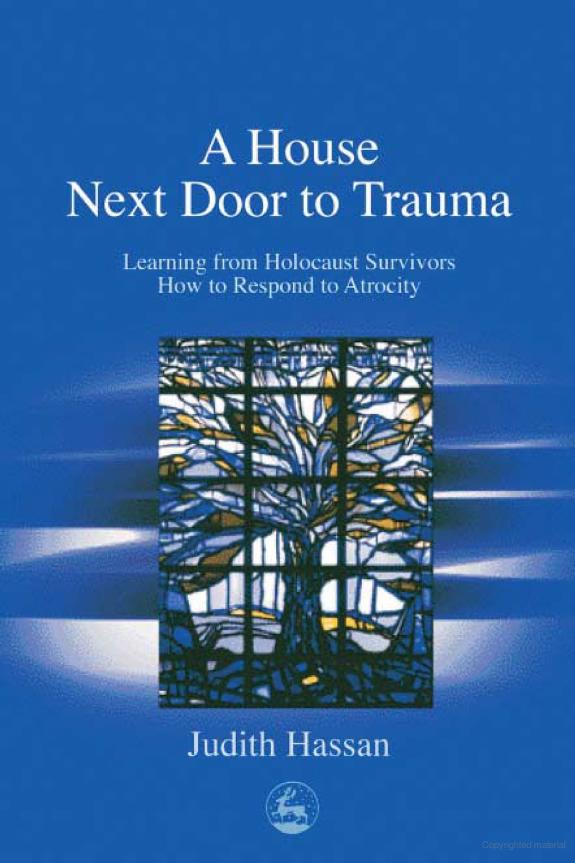
A House Next Door to Trauma

A House Next Door to Trauma

Learning from Holocaust Survivors How to Respond to Atrocity

by Judith Hassan

320 pages· 2003· ISBN 9781846421914

Browse books you can read free on Readfeed

No club is reading this yet — be the first to start one

Start a club free
About
'Judith Hassan has written a book which will strike readers on several levels. Dedicated to the memory of her parents - her mother was a refugee from Nazi Germany - it tells of the growing understanding derived from working with Holocaust-survivors. The Holocaust brings many lessons for all of us. Hassan's particular lesson is that it is possible to help those who carry deep within them old and desperate wounds. The lesson extends to suggesting that we could do the same for others whose wounds are fresher, perhaps more accessible. And she shows us how help might reasonably be given.' - Jewish Chronicle 'This book describes what the author has learned, from working at the Shalvata Centre in London and setting up the Holocaust Survivors' Centre (HSC) next door, about the sort of services that can help those who survived the trauma of life in a Nazi concentration camp, or flight in the kindertransport, to realize their capacity for joy and contentment in the latter part of their lives.' - Jewish Quarterly 'Some suffering, like certain grief leaves scars beyond those who experience it themselves. Their children carry it in their wounded souls like secrets that are too burdensome, or nightmares that are too disturbing to be faced. It is not a matter of physical or psychological wounds, for these are not even tangible. They often escape detection from traditional medicine or therapy, emanating from experiences transmitted from one generation to the next, each equally traumatised. But for those who can recognise these wounds, as Judith Hassan does in this book rich in understanding and compassion, the pain remains vivid.' Elie Wiesel, Andrew W. Mellon Professor in the Humanities, Boston University How do we respond to extreme suffering? Judith Hassan faced this challenge by listening to the survivors and learning from them as the experts on their own experiences. She discovered that conventional therapeutic responses did not seem to go far enough and she has spent twenty-five years developing innovative services for survivors of the Nazi Holocaust, as well as more recent refugees from Bosnia. Judith Hassan has developed a model that addresses the trauma of individuals who faced starvation, torture and who witnessed the murder of close family members. Her book discusses the kinds of demands placed on those who work with these survivors and opens up issues for others in the field of war trauma to answer in their own particular and appropriate way. Translating the language of liberation into practice, A House Next Door to Trauma points to a different way of becoming a neighbour to all those who suffer extreme war experiences. It is clear and hopeful in the positive potential it lends to therapeutic work in this area.

Discuss A House Next Door to Trauma with other readers

Join or start a book club for A House Next Door to Trauma on Readfeed. Live chat, shared reading progress, and AI discussion questions — free to get started.

Frequently asked questions

How do I join a book club for A House Next Door to Trauma?

Sign up free on Readfeed, then browse public clubs or start your own club with A House Next Door to Trauma as the current read. Invite friends with a share link and discuss together with live chat and AI discussion questions.

Can I discuss A House Next Door to Trauma with other readers online?

Yes. Readfeed book clubs let you chat live, share progress, and join discussions about A House Next Door to Trauma with readers worldwide — whether your club is virtual, in-person, or hybrid.

Is Readfeed free?

Yes. Creating an account and joining book clubs is free. Sign up to find readers who love the same books and start discussing today.