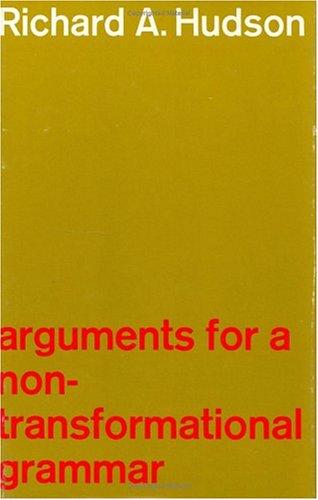
Arguments for a non-transformational grammar

Arguments for a non-transformational grammar

by Richard A. Hudson

1976

Browse books you can read free on Readfeed

No club is reading this yet — be the first to start one

Start a club free
About
For the past decade, the dominant transformational theory of syntax has produced the most interesting insights into syntactic properties. Over the same period another theory, systemic grammar, has been developed very quietly as an alternative to the transformational model. In this work Richard A. Hudson outlines "daughter-dependency theory," which is derived from systemic grammar, and offers empirical reasons for preferring it to any version of transformational grammar. The goal of daughter-dependency theory is the same as that of Chomskyan transformational grammar--to generate syntactic structures for all (and only) syntactically well-formed sentences that would relate to both the phonological and the semantic structures of the sentences. However, unlike transformational grammars, those based on daughter-dependency theory generate a single syntactic structure for each sentence. This structure incorporates all the kinds of information that are spread, in a transformational grammar, over to a series of structures (deep, surface, and intermediate). Instead of the combination of phrase-structure rules and transformations found in transformational grammars, daughter-dependency grammars contain rules with the following functions: classification, dependency-marking, or ordering. Hudson's arguments for a non-transformational grammar stress the capacity of daughter-dependency theory to reflect the facts of language structure and to capture generalizations that transformational models miss. An attraction of Hudson's theory is that the syntax is more concrete, with no abstract underlying elements. In the appendixes, the author outlines a partial grammar for English and a small lexicon and distinguishes his theory from standard dependency theory. --From publisher's description.

Discuss Arguments for a non-transformational grammar with other readers

Join or start a book club for Arguments for a non-transformational grammar on Readfeed. Live chat, shared reading progress, and AI discussion questions — free to get started.

Frequently asked questions

How do I join a book club for Arguments for a non-transformational grammar?

Sign up free on Readfeed, then browse public clubs or start your own club with Arguments for a non-transformational grammar as the current read. Invite friends with a share link and discuss together with live chat and AI discussion questions.

Can I discuss Arguments for a non-transformational grammar with other readers online?

Yes. Readfeed book clubs let you chat live, share progress, and join discussions about Arguments for a non-transformational grammar with readers worldwide — whether your club is virtual, in-person, or hybrid.

Is Readfeed free?

Yes. Creating an account and joining book clubs is free. Sign up to find readers who love the same books and start discussing today.