MONASTIC INNOVATIONS-Computational, Biologic, Evolutionary, Multi-Cultural UPDATES of Mundane Foundations of Thought: How the World's Top Thinkers Hear/Read, Model, Speak/Write Geometries of Thought
by Richard Tabor Greene
No club is reading this yet — be the first to start one
You do not scan this book for interesting ideas. You must do its very specific mental exercises--17 essential ones and 10 peripheral ones. They ENORMOUSLY improve your overall mental productivity when done. Increased mental productivity becomes more tries, making more diversity attempted, which becomes more CREATIVITY.
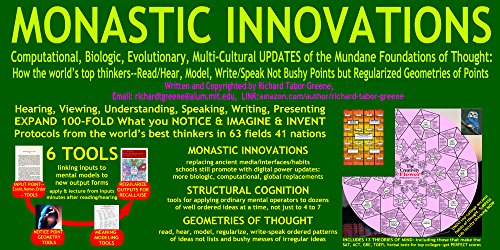
The SIX TOOLS for thought in this book are foundational--they change extremely basic aspects of thought--ancient media and interfaces of thought, things used dozens of times every hour of your life. SLIGHT changes in them result in HUGE increases in overall hourly/daily mental productivity. HOWEVER changing such basic habits is hard, interior, and culture-changing work.
The SIX TOOLS of this book are selected from 33 Tools for Creativity Leadership in a larger book, that is being offered to every high school and college in China. The idea in China is re-found ALL of thought on updated--more biologic, more computational, more evolutionary, more multi-cultural--media and interfaces.
The first 3 tools are ways of inputting (hearing or reading) the GEOMETRY OF POINTS before you. Nearly no adults anywhere get the count/names/ordering of all points before them. We scan for interesting bits, assimilating them into old established geometries of thought, never noticing the differing geometries of thought the points were in.
The author of this book watched University of Chicago professors in this way assimilate Japanese total quality ideas and tools into individualist, elitist, analytic American ways, stripping all power from them, so they fit nicely without improving/changing anything. This was elite "top" professors. Years earlier Harvard-MIT professors did the same--stripping out the word "Japanese" from quality techniques and replacing it with "lean", allowing Americans the mis-leading idea that LEAN techniques were inventions of US professors, not of Japanese workers!! This is our normal way of inputting ONLY in ways that preserve what we already WANT to think, by missing the geometry of points each point is located in!
The first 3 tools concern seeing POINT structures, CAUSAL structures, IMAGE & ACTION structures--fully, diversely, completely, in detail, with multi-levels. No one who buys this book is capable of this today--no one, it has been thoroughly tested. Only a few top Harvard and MIT faculty can do any of the tools in this book.
The tools in this book came from 3 sources--a study of how top 20 Harvard-MIT faculty ways of thought differed from average faculty ways, a study of 82+ top creators in 60+ genres of design for how their designing differed from average designers, and a larger study of 8000+ eminent people in 63 professions, 41 nations for routes to excellence in all fields. 54 routes to the top were found and ONE of them was--rising to the top by "out-thinking" all others. The specific methods of those top thinkers form the 6 tools in this book and the 33 larger book tools.
The 2nd set of are 2--how to turn various inputs of point-cause-image-action structure into your own mental models so ALL INPUTS IMPROVE what you notice and how you can respond to things = increase your POWER. The 3rd set of tools is just 1--a REPLACEMENT FOR PROSE TEXT as what you read and write. By regularizing point Structure--Count, Names, Order--your outputs convey ALL points to ALL easily. Whatever you speak or write conveys the total NUMBER, NAMES, ORDERING, and LAYERS of points--instantly, with them not hidden, in strings of anonymous prose code. Your outputs can be instantly applied, later recalled
Discuss MONASTIC INNOVATIONS-Computational, Biologic, Evolutionary, Multi-Cultural UPDATES of Mundane Foundations of Thought: How the World's Top Thinkers Hear/Read, Model, Speak/Write Geometries of Thought with other readers
Join or start a book club for MONASTIC INNOVATIONS-Computational, Biologic, Evolutionary, Multi-Cultural UPDATES of Mundane Foundations of Thought: How the World's Top Thinkers Hear/Read, Model, Speak/Write Geometries of Thought on Readfeed. Live chat, shared reading progress, and AI discussion questions — free to get started.
Frequently asked questions
How do I join a book club for MONASTIC INNOVATIONS-Computational, Biologic, Evolutionary, Multi-Cultural UPDATES of Mundane Foundations of Thought: How the World's Top Thinkers Hear/Read, Model, Speak/Write Geometries of Thought?
Sign up free on Readfeed, then browse public clubs or start your own club with MONASTIC INNOVATIONS-Computational, Biologic, Evolutionary, Multi-Cultural UPDATES of Mundane Foundations of Thought: How the World's Top Thinkers Hear/Read, Model, Speak/Write Geometries of Thought as the current read. Invite friends with a share link and discuss together with live chat and AI discussion questions.
Can I discuss MONASTIC INNOVATIONS-Computational, Biologic, Evolutionary, Multi-Cultural UPDATES of Mundane Foundations of Thought: How the World's Top Thinkers Hear/Read, Model, Speak/Write Geometries of Thought with other readers online?
Yes. Readfeed book clubs let you chat live, share progress, and join discussions about MONASTIC INNOVATIONS-Computational, Biologic, Evolutionary, Multi-Cultural UPDATES of Mundane Foundations of Thought: How the World's Top Thinkers Hear/Read, Model, Speak/Write Geometries of Thought with readers worldwide — whether your club is virtual, in-person, or hybrid.
Is Readfeed free?
Yes. Creating an account and joining book clubs is free. Sign up to find readers who love the same books and start discussing today.