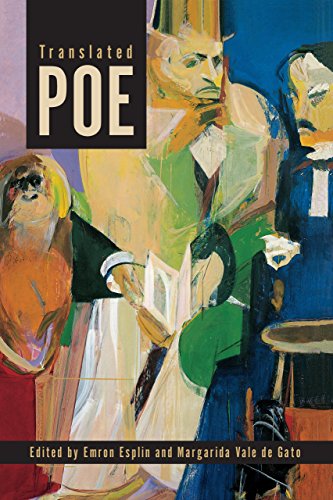
Translated Poe (Perspectives on Edgar Allan Poe)
by Takayuki Tatsumi, George Monteiro, Margarida Vale de Gato, Lois Davis Vines, Emron Esplin, Ástráður Eysteinsson, Rafael Olea Franco, J. Scott Miller, Woosung Kang, Ayşe Nihal Akbulut, Bouchra Benlemlih, Liviu Cotrău, Hivren Demir-Atay, Marlene Hansen Esplin, Lenita Esteves, Zongxin Feng, Maria Filippakopoulou, Daniel Göske, Daniela Hăisan, Magda Mansour Hasabelnaby, Aimei Ji, Henri Justin, Marius Littschwager, Elvira Osipova, Renata Philippov, Margarita Rigal-Aragón, Santiago Rodríguez Guerrero-Strachan, Christopher Rollason, Ugo Rubeo, Alexandra Urakova, Pamela Vicenteño Bravo, Johan Wijkmark, Eysteinn Þorvaldsson
No club is reading this yet — be the first to start one
Translated Poe is not preoccupied with judging the “quality” of any given Poe translation nor with assessing what a specific translation of Poe must or should have done. Rather, the volume demonstrates how Poe’s translations constitute multiple contextual interpretations, testifying to how this prolific author continues to help us read ourselves and the world(s) we live in. The examples of how Poe’s works were spread abroad remind us that literature depends as much on authorial creation and timely readership as on the languages and worlds through which a piece of literature circulates after its initial publication in its first language. This recasting of signs and symbols that intervene in other cultures when a text is translated is one of the principal subjects of the humanistic discipline of Translation Studies, dealing with the the products, functions, and processes of translation as both a cognitive and socially regulated activity. Both literary history and the history of translation benefit from this book’s focus on Poe, whose translated fortune has helped to shape literary modernity, in many cases importantly redefining the target literary systems. Furthermore, we envision this book as a fountain of resources for future Poe scholars from various global sites, including the United States, since the cases of Poe’s translations—both exceptional and paradigmatic—prove that they are also levers that force the reassessment of the source text in its native literature.
Discuss Translated Poe (Perspectives on Edgar Allan Poe) with other readers
Join or start a book club for Translated Poe (Perspectives on Edgar Allan Poe) on Readfeed. Live chat, shared reading progress, and AI discussion questions — free to get started.
Frequently asked questions
How do I join a book club for Translated Poe (Perspectives on Edgar Allan Poe)?
Sign up free on Readfeed, then browse public clubs or start your own club with Translated Poe (Perspectives on Edgar Allan Poe) as the current read. Invite friends with a share link and discuss together with live chat and AI discussion questions.
Can I discuss Translated Poe (Perspectives on Edgar Allan Poe) with other readers online?
Yes. Readfeed book clubs let you chat live, share progress, and join discussions about Translated Poe (Perspectives on Edgar Allan Poe) with readers worldwide — whether your club is virtual, in-person, or hybrid.
Is Readfeed free?
Yes. Creating an account and joining book clubs is free. Sign up to find readers who love the same books and start discussing today.