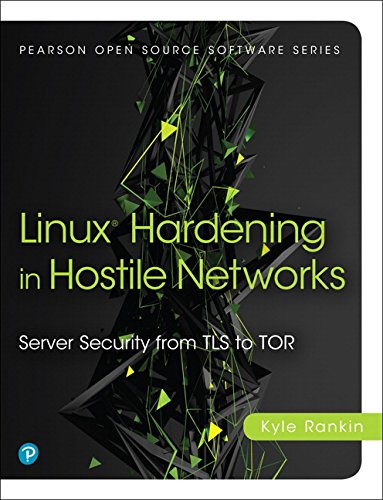
Linux Hardening in Hostile Networks: Server Security from TLS to Tor (Pearson Open Source Software Development Series)
by Kyle Rankin
Implement Industrial-Strength Security on Any Linux Server
In an age of mass surveillance, when advanced cyberwarfare weapons rapidly migrate into every hacker’s toolkit, you can’t rely on outdated security methods–especially if you’re responsible for Internet-facing services. In Linux® Hardening in Hostile Networks, Kyle Rankin helps you to implement modern safeguards that provide maximum impact with minimum effort and to strip away old techniques that are no longer worth your time.
Rankin provides clear, concise guidance on modern workstation, server, and network hardening, and explains how to harden specific services, such as web servers, email, DNS, and databases. Along the way, he demystifies technologies once viewed as too complex or mysterious but now essential to mainstream Linux security. He also includes a full chapter on effective incident response that both DevOps and SecOps can use to write their own incident response plan.
Each chapter begins with techniques any sysadmin can use quickly to protect against entry-level hackers and presents intermediate and advanced techniques to safeguard against sophisticated and knowledgeable attackers, perhaps even state actors. Throughout, you learn what each technique does, how it works, what it does and doesn’t protect against, and whether it would be useful in your environment.
- Apply core security techniques including 2FA and strong passwords
- Protect admin workstations via lock screens, disk encryption, BIOS passwords, and other methods
- Use the security-focused Tails distribution as a quick path to a hardened workstation
- Compartmentalize workstation tasks into VMs with varying levels of trust
- Harden servers with SSH, use apparmor and sudo to limit the damage attackers can do, and set up remote syslog servers to track their actions
- Establish secure VPNs with OpenVPN, and leverage SSH to tunnel traffic when VPNs can’t be used
- Configure a software load balancer to terminate SSL/TLS connections and initiate new ones downstream
- Set up standalone Tor services and hidden Tor services and relays
- Secure Apache and Nginx web servers, and take full advantage of HTTPS
- Perform advanced web server hardening with HTTPS forward secrecy and ModSecurity web application firewalls
- Strengthen email security with SMTP relay authentication, SMTPS, SPF records, DKIM, and DMARC
- Harden DNS servers, deter their use in DDoS attacks, and fully implement DNSSEC
- Systematically protect databases via network access control, TLS traffic encryption, and encrypted data storage
- Respond to a compromised server, collect evidence, and prevent future attacks
Register your product at informit.com/register for convenient access to downloads, updates, and corrections as they become available.
Discuss Linux Hardening in Hostile Networks: Server Security from TLS to Tor (Pearson Open Source Software Development Series) with other readers
Join or start a book club for Linux Hardening in Hostile Networks: Server Security from TLS to Tor (Pearson Open Source Software Development Series) on Readfeed. Live chat, shared reading progress, and AI discussion questions — free to get started.
Frequently asked questions
How do I join a book club for Linux Hardening in Hostile Networks: Server Security from TLS to Tor (Pearson Open Source Software Development Series)?
Sign up free on Readfeed, then browse public clubs or start your own club with Linux Hardening in Hostile Networks: Server Security from TLS to Tor (Pearson Open Source Software Development Series) as the current read. Invite friends with a share link and discuss together with live chat and AI discussion questions.
Can I discuss Linux Hardening in Hostile Networks: Server Security from TLS to Tor (Pearson Open Source Software Development Series) with other readers online?
Yes. Readfeed book clubs let you chat live, share progress, and join discussions about Linux Hardening in Hostile Networks: Server Security from TLS to Tor (Pearson Open Source Software Development Series) with readers worldwide — whether your club is virtual, in-person, or hybrid.
Is Readfeed free?
Yes. Creating an account and joining book clubs is free. Sign up to find readers who love the same books and start discussing today.