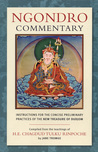
Ngondro Commentary: Instructions for the Concise Preliminary Practices
by Jane Tromge
As we undertake ngondro, we acquire certain skills that we will use again and again in Vajrayana practice. We learn to contemplate, to develop a visualization, to recite prayers and mantra, to perform prostrations and mandala offerings, to dissolve the visualization, and to rest in nonconceptual meditation. We begin our practice with pure motivation, follow the lineage instructions in each section, redirect our attention whenever it wanders, and close with the pure dedication of virtue to all sentient beings. In general, we learn how to meditate.
The ngondro in Tibetan Buddhism establishes the foundation for the entire Vajrayana path—it is as fundamental to the practitioner’s development as the alphabet is to written language. Among the preliminaries of the various lineages, the Dudjom Tersar Ngondro of the Nyingma tradition—on which this commentary is based—is possibly the most concise. Written, then concealed in the eight century by Padmasambhava (Guru Rinpoche), it was intended for these times when few people have sufficient leisure to fully practice. H.H. Dudjom Lingpa (1835–1904) revealed this treasure; his incarnation, H.H. Dudjom Jigdral Yeshe Dorje (1904–1987), from whom I had the excellent fortune to receive these teachings, clarified the text and taught it widely throughout his life.
Practice of the outer and the extraordinary preliminaries provides a strong foundation for spiritual development. The teachings on the four thoughts give rise to the renunciation of ordinary attachments and guide us toward what is beneficial. Refuge creates a sense of protection and blessing. Bodhicitta clarifies our motivation and arouses our compassion—we acknowledge our highest spiritual aspirations. Mandala offerings generate the accumulation of merit and the revelation of pristine awareness that we will need to fulfill our aspirations. Vajrasattva provides a method by which we can purify the obstacles to enlightenment—the mind’s poisons, habitual patterns, negative karma, and intellectual obscurations. Guru yoga enables us to receive the pure qualities of the lama’s realization. Transference of consciousness allows us to continue our path uninterrupted after this lifetime by finding rebirth in the pureland.
Thus these are extremely powerful practices for turning the mind toward dharma, for purifying obscurations, and for bringing forth the qualities of realization. They enhance devotion to the dharma and receptivity to the highest level of teachings, the Great Perfection. For practitioners with receptive minds, the Great Perfection perspective can evolve from ngondro itself.”—His Eminence Chagdud Tulku Rinpoche
Discuss Ngondro Commentary: Instructions for the Concise Preliminary Practices with other readers
Join or start a book club for Ngondro Commentary: Instructions for the Concise Preliminary Practices on Readfeed. Live chat, shared reading progress, and AI discussion questions — free to get started.
Frequently asked questions
How do I join a book club for Ngondro Commentary: Instructions for the Concise Preliminary Practices?
Sign up free on Readfeed, then browse public clubs or start your own club with Ngondro Commentary: Instructions for the Concise Preliminary Practices as the current read. Invite friends with a share link and discuss together with live chat and AI discussion questions.
Can I discuss Ngondro Commentary: Instructions for the Concise Preliminary Practices with other readers online?
Yes. Readfeed book clubs let you chat live, share progress, and join discussions about Ngondro Commentary: Instructions for the Concise Preliminary Practices with readers worldwide — whether your club is virtual, in-person, or hybrid.
Is Readfeed free?
Yes. Creating an account and joining book clubs is free. Sign up to find readers who love the same books and start discussing today.