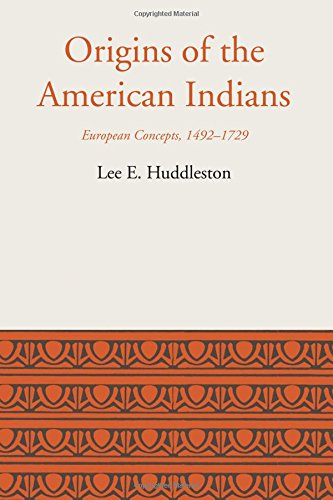
Origins of the American Indians: European Concepts, 1492-1729 (Llilas - Latin American Monograph)
by Lee Eldridge Huddleston
No club is reading this yet — be the first to start one
The American Indian—origin, culture, and language—engaged the best minds of Europe from 1492 to 1729. Were the Indians the result of a co-creation? Were they descended from the Ten Lost Tribes of Israel? Could they have emigrated from Carthage, Phoenicia, or Troy? All these and many other theories were proposed.
How could scholars account for the multiplicity of languages among the Indians, the differences in levels of culture? And how did the Indian arrive in America—by using as a bridge a now-lost continent or, as was later suggested by some persons in the light of an expanding knowledge of geography, by using the Bering Strait as a migratory route?
Most of the theories regarding the American Indian were first advanced in the sixteenth century. In this distinctive book Lee E. Huddleston looks carefully into those theories and proposals. From many research sources he weaves an historical account that engages the reader from the very first.
The two most influential men in an early-developing controversy over Indian origins were Joseph de Acosta and Gregorio García. Approaching the subject with restraint and with a critical eye, Acosta, in 1590, suggested that the presence of diverse animals in America indicated a land connection with the Old World. On the other hand, García accepted several theories as equally possible and presented each in the strongest possible light in his Origen de los indios of 1607.
The critical position of Acosta and the credulous stand of García were both developed in Spanish writing in the seventeenth century. The Acostans settled on an Asiatic derivation for the Indians; the Garcians continued to accept most sources as possible. The Garcian position triumphed in Spain, as was shown by the republication of García’s Origen in 1729 with considerable additions consistent within the original framework.
Outside of Spain, Acosta was the more influential of the two. His writings were critical in the thinking of such men as Joannes de Laet (who bested Grotius in their polemic on Indian origins), Georg Horn, and Samuel Purchas. By the end of the seventeenth century the Acostans of Northern Europe had begun to apply physical characteristics to the determination of Indian origins, and by the early eighteenth century these new criteria were beginning to place the question of Indian origins on a more nearly scientific level.
Discuss Origins of the American Indians: European Concepts, 1492-1729 (Llilas - Latin American Monograph) with other readers
Join or start a book club for Origins of the American Indians: European Concepts, 1492-1729 (Llilas - Latin American Monograph) on Readfeed. Live chat, shared reading progress, and AI discussion questions — free to get started.
Frequently asked questions
How do I join a book club for Origins of the American Indians: European Concepts, 1492-1729 (Llilas - Latin American Monograph)?
Sign up free on Readfeed, then browse public clubs or start your own club with Origins of the American Indians: European Concepts, 1492-1729 (Llilas - Latin American Monograph) as the current read. Invite friends with a share link and discuss together with live chat and AI discussion questions.
Can I discuss Origins of the American Indians: European Concepts, 1492-1729 (Llilas - Latin American Monograph) with other readers online?
Yes. Readfeed book clubs let you chat live, share progress, and join discussions about Origins of the American Indians: European Concepts, 1492-1729 (Llilas - Latin American Monograph) with readers worldwide — whether your club is virtual, in-person, or hybrid.
Is Readfeed free?
Yes. Creating an account and joining book clubs is free. Sign up to find readers who love the same books and start discussing today.