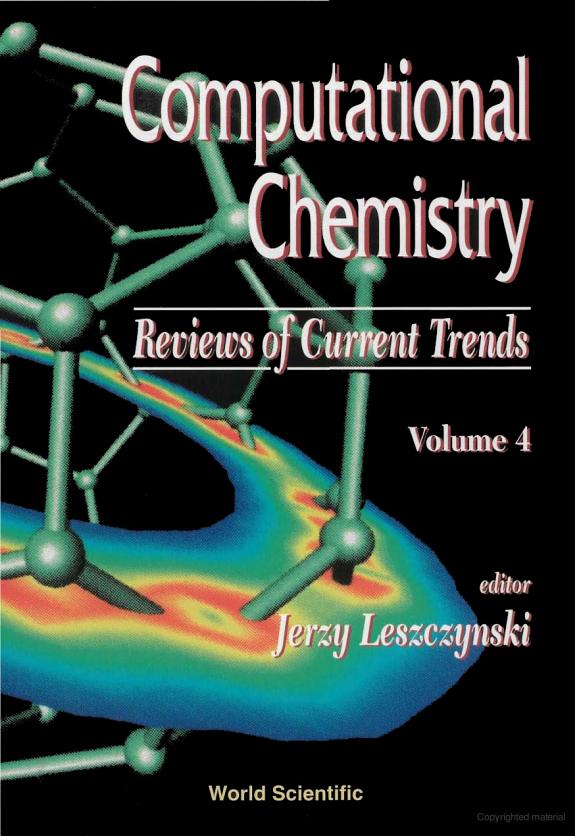
Computational Chemistry: Reviews of Current Trends

Computational Chemistry: Reviews of Current Trends

by Jerzy Leszczynski

304 pages· 1999· ISBN 9789814494540

Browse books you can read free on Readfeed

No club is reading this yet — be the first to start one

Start a club free
About
This volume presents a balanced blend of methodological and applied contributions. It supplements well the first three volumes of the series, revealing results of current research in computational chemistry. It also reviews the topographical features of several molecular scalar fields. A brief discussion of topographical concepts is followed by examples of their application to several branches of chemistry. The size of a basis set applied in a calculation determines the amount of computer resources necessary for a particular task. The details of a common strategy — the ab initio model potential method — which could be used to minimize such a task are revealed in the subsequent contribution. Such an approach is applied to atoms, molecules and solids. Two chapters are devoted to the prediction of solvent effects in biological systems. These effects are significant for interactions of nucleic acid bases and crucial for an evaluation of the free energies that govern the associations of macromolecules in aqueous solutions. A chapter on the developments and applications of the multireference Moller–Plesset method could be used as a reference in theoretical studies of systems where both the dynamical and nondynamical correlation effects should be accounted for. This technique is an efficient tool in such investigations. An explosive application of computational techniques — studies of detonation initiation and sensitivity in energetic compounds — is discussed in detail in the last chapter. The computational treatment of such unstable compounds allows the prediction of their crucial properties without being subject to their destructive forces. Contents:Topography of Atomic and Molecular Scalar Fields (S R Gadre)The Ab Initio Model Potential Method: A Common Strategy for Effective Core Potential and Embedded Cluster Calculations (L Seijo & Z Barandiaran)Continuum Models of Macromolecular Association in Aqueous Solution (M A Olson)Interactions of Nucleic Acid Bases: The Role of Solvent (M Orozco et al.)Recent Advances in Multireference Møller–Plesset Method (K Hirao et al.)Detonation Initiation and Sensitivity in Energetic Compounds: Some Computational Treatments (P Politzer & H E Alper) Readership: Graduate students and researchers in computational chemistry. Keywords:Continuum Model;Protein-Protein Association;Protein-Nucleic Acid Binding;Free Energy of Complex Formation;Molecular Recognition;Poisson-Boltzmann Equation;Dielectric Models;Solvation;Hydrophobic Effect;Protein Reorganization;ECP;AIMP;Core Potential;Embedding Potential;Model Potential;Ab Initio;Embedded Cluster;Relativistic;Impurity;Doped Crystal

Discuss Computational Chemistry: Reviews of Current Trends with other readers

Join or start a book club for Computational Chemistry: Reviews of Current Trends on Readfeed. Live chat, shared reading progress, and AI discussion questions — free to get started.

Frequently asked questions

How do I join a book club for Computational Chemistry: Reviews of Current Trends?

Sign up free on Readfeed, then browse public clubs or start your own club with Computational Chemistry: Reviews of Current Trends as the current read. Invite friends with a share link and discuss together with live chat and AI discussion questions.

Can I discuss Computational Chemistry: Reviews of Current Trends with other readers online?

Yes. Readfeed book clubs let you chat live, share progress, and join discussions about Computational Chemistry: Reviews of Current Trends with readers worldwide — whether your club is virtual, in-person, or hybrid.

Is Readfeed free?

Yes. Creating an account and joining book clubs is free. Sign up to find readers who love the same books and start discussing today.