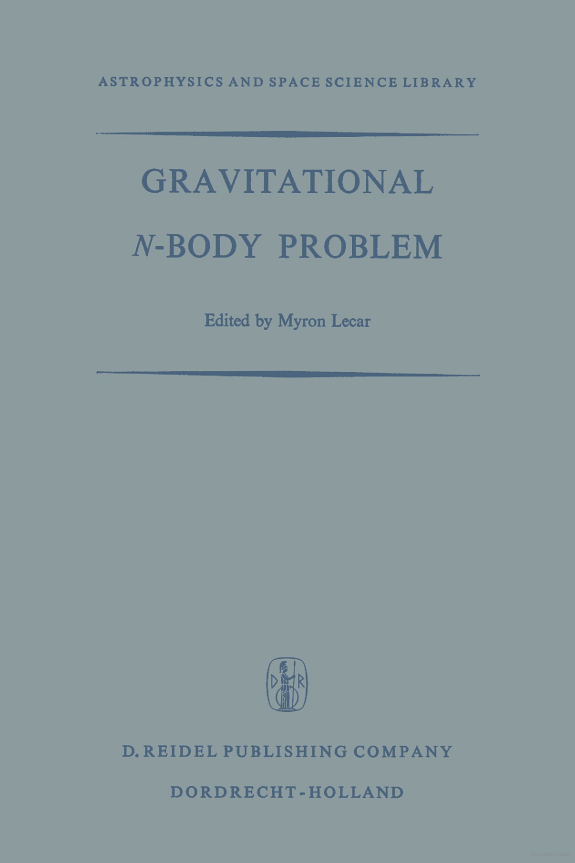
Gravitational N-Body Problem

Gravitational N-Body Problem

Proceedings of the Iau Colloquium No. 10 Held in Cambridge, England August 12–15, 1970

by M. Lecar

441 pages· 2012· ISBN 9789401028707
About
This volume contains the proceedings of the third IAU conference on the Gravita tional N-Body Problem. The first IAU conference [IJ, six years ago, was motivated by the renaissance in Celestial Mechanics following the launching of artificial earth satellites, and was an attempt to bring to bear on the problems of Stellar Dynamics the sophisticated analytical techniques of Celestial Mechanics. That meeting was an outgrowth of the 'Summer Institutes in Celestial Mechanics' initiated by Dirk Brouwer. By the second IAU conference [2J, our interest had been captured by the attempts to simulate stellar systems on the computer. Computer simulation is now an essential part of stellar dynamics; journals of computational physics have started in the United Kingdom and in the United States and symposia on computer simulation of many-body problems have become a perennial event [3,4, 5]. Although our early hopes that the computer would 'solve' our problem have been tempered by experience, some techniques of computer simulation have now matured through five years of testing and use. A working description of the six most popular methods is appended to this volume. During the past three years, stellar dynamicists have followed closely the develop ments in the related field of Plasma Physics. The contexts of Plasma and Stellar Physics are deceptively similar; at first, results from Plasma Physics were bodily transferred to stellar systems by 'changing the sign of the coupling'. We are more sophisticated and more skeptical now.

Discuss Gravitational N-Body Problem with other readers

Join or start a book club for Gravitational N-Body Problem on Readfeed. Live chat, shared reading progress, and AI discussion questions — free to get started.

Frequently asked questions

How do I join a book club for Gravitational N-Body Problem?

Sign up free on Readfeed, then browse public clubs or start your own club with Gravitational N-Body Problem as the current read. Invite friends with a share link and discuss together with live chat and AI discussion questions.

Can I discuss Gravitational N-Body Problem with other readers online?

Yes. Readfeed book clubs let you chat live, share progress, and join discussions about Gravitational N-Body Problem with readers worldwide — whether your club is virtual, in-person, or hybrid.

Is Readfeed free?

Yes. Creating an account and joining book clubs is free. Sign up to find readers who love the same books and start discussing today.