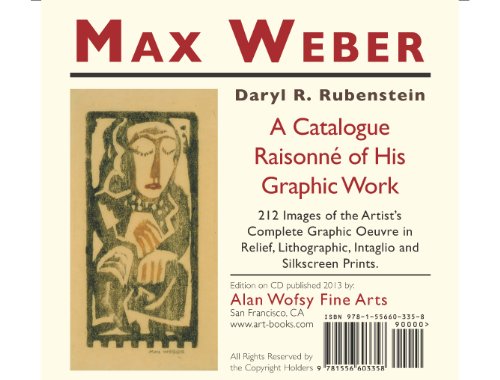
Max Weber. A Catalogue Raisonné of His Graphic Work.
by Daryl R. Rubenstein
No club is reading this yet — be the first to start one
Max Weber was born into a Jewish family in Bialystok, then part of Russia, in 1881. At the end of the 19th Century, the majority of the residents of Bialystok were Jewish. The City was originally part of Poland and became Polish once again after World War I. The Weber family moved to Brooklyn in 1891, when Max was 10. He attended public schools in Brooklyn and then the Pratt Institute, where his teacher-mentor was Arthur Wesley Dow (1877-1922), a proponent of Gauguin and of Japanese woodcuts. Max studied and lived in Paris between 1905-1908 and the influence of Picasso s late Rose and African periods predominate in the artist s woodcuts and linoleum cuts beginning in 1910 (R. 4-8). His Cubist period, again inspired by Picasso and his contemporaries, is most noticeable in 1919-1920 (R. 9-14). The artist s relief prints between 1920-1954 combine the earlier primitive motifs in an Expressionist style, sometimes incorporating Jewish motifs (R. 27, 30, 34 and 35). Weber is one of the few Modernist artists to use Jewish motifs and this may be due to the fact that he grew up in areas that were largely Jewish and may have therefore felt secure in his religious heritage. His earliest lithographs from 1916-1919 are in an Expressionist idiom (R. 50-52) but they become increasing Naturalistic in subsequent years, though still with a stolid primitive quality.
During his eighty year life (he died in Great Neck, New York in 1961), Weber produced 110 original prints. His first and only etching (R. 1) was produced in Paris circa 1905-1906. This was following by two monotypes in 1906-1907, also while in Paris. From 1919 to 1954 he created 45 relief prints (R. 4-48): woodcuts and linoleum cuts. He made 61 lithographs between1916 and 1932 (R. 49-109). His final graphic work was a silkscreen in 1956 (R. 110).
The first edition of this catalogue raisonné by Daryl Rubenstein was published in 1980 by the University of Chicago Press and the 130 catalogue illustrations were contained on two microfiche sheets. This new searchable PDF edition has converted the microfiche images to digital images. The late Daryl Rubenstein s husband Lee G. Rubenstein and her son Barton Rubenstein have provided the publisher with an additional 82 images, so that the reader can now see variations of many of the prints as well as a few that were not reproduced in the first edition. These new supplemental images are identified as 2013 edition images. This new edition makes a few corrections to the text and updates the bibliography.
Discuss Max Weber. A Catalogue Raisonné of His Graphic Work. with other readers
Join or start a book club for Max Weber. A Catalogue Raisonné of His Graphic Work. on Readfeed. Live chat, shared reading progress, and AI discussion questions — free to get started.
Frequently asked questions
How do I join a book club for Max Weber. A Catalogue Raisonné of His Graphic Work.?
Sign up free on Readfeed, then browse public clubs or start your own club with Max Weber. A Catalogue Raisonné of His Graphic Work. as the current read. Invite friends with a share link and discuss together with live chat and AI discussion questions.
Can I discuss Max Weber. A Catalogue Raisonné of His Graphic Work. with other readers online?
Yes. Readfeed book clubs let you chat live, share progress, and join discussions about Max Weber. A Catalogue Raisonné of His Graphic Work. with readers worldwide — whether your club is virtual, in-person, or hybrid.
Is Readfeed free?
Yes. Creating an account and joining book clubs is free. Sign up to find readers who love the same books and start discussing today.