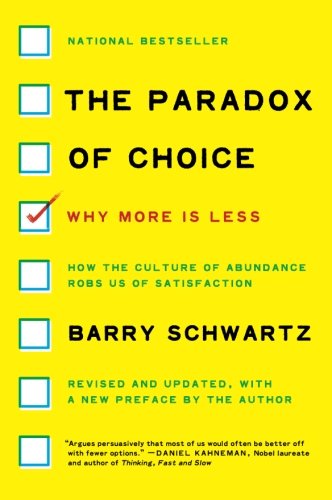
The Paradox of Choice: Why More Is Less, Revised Edition
by Barry Schwartz
No club is reading this yet — be the first to start one
2 readers have this book on their Readfeed shelves
In the spirit of Alvin Toffler’s Future Shock, a social critique of our obsession with choice, and how it contributes to anxiety, dissatisfaction and regret. This paperback includes a new preface from the author.
Whether we're buying a pair of jeans, ordering a cup of coffee, selecting a long-distance carrier, applying to college, choosing a doctor, or setting up a 401(k), everyday decisions—both big and small—have become increasingly complex due to the overwhelming abundance of choice with which we are presented.
As Americans, we assume that more choice means better options and greater satisfaction. But beware of excessive choice: choice overload can make you question the decisions you make before you even make them, it can set you up for unrealistically high expectations, and it can make you blame yourself for any and all failures. In the long run, this can lead to decision-making paralysis, anxiety, and perpetual stress. And, in a culture that tells us that there is no excuse for falling short of perfection when your options are limitless, too much choice can lead to clinical depression.
In The Paradox of Choice, Barry Schwartz explains at what point choice—the hallmark of individual freedom and self-determination that we so cherish—becomes detrimental to our psychological and emotional well-being. In accessible, engaging, and anecdotal prose, Schwartz shows how the dramatic explosion in choice—from the mundane to the profound challenges of balancing career, family, and individual needs—has paradoxically become a problem instead of a solution. Schwartz also shows how our obsession with choice encourages us to seek that which makes us feel worse.
By synthesizing current research in the social sciences, Schwartz makes the counter intuitive case that eliminating choices can greatly reduce the stress, anxiety, and busyness of our lives. He offers eleven practical steps on how to limit choices to a manageable number, have the discipline to focus on those that are important and ignore the rest, and ultimately derive greater satisfaction from the choices you have to make.
Discussion questions for The Paradox of Choice: Why More Is Less, Revised Edition
Bring these to your book club — or discuss them with readers on Readfeed.
- 1
How has your own daily life been impacted by the explosion of choices in modern consumer culture, and can you recall a specific instance where having too many options led to decision paralysis or regret?
- 2
Barry Schwartz distinguishes between "maximizers" (those who strive to make the absolute best choice) and "satisficers" (those who settle for something that is "good enough"). Where do you fall on this spectrum, and how does your approach affect your overall happiness?
- 3
In what ways does modern society's obsession with limitless choice intersect with the pressure to achieve perfection in areas like career, relationships, and lifestyle?
Readers also shelved

Discuss The Paradox of Choice: Why More Is Less, Revised Edition with other readers
Join or start a book club for The Paradox of Choice: Why More Is Less, Revised Edition on Readfeed. Live chat, shared reading progress, and AI discussion questions — free to get started.
Frequently asked questions
How do I join a book club for The Paradox of Choice: Why More Is Less, Revised Edition?
Sign up free on Readfeed, then browse public clubs or start your own club with The Paradox of Choice: Why More Is Less, Revised Edition as the current read. Invite friends with a share link and discuss together with live chat and AI discussion questions.
Can I discuss The Paradox of Choice: Why More Is Less, Revised Edition with other readers online?
Yes. Readfeed book clubs let you chat live, share progress, and join discussions about The Paradox of Choice: Why More Is Less, Revised Edition with readers worldwide — whether your club is virtual, in-person, or hybrid.
Is Readfeed free?
Yes. Creating an account and joining book clubs is free. Sign up to find readers who love the same books and start discussing today.