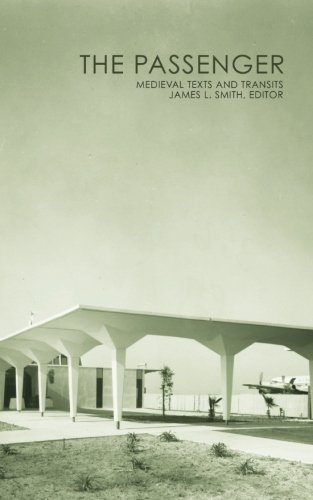
The Passenger: Medieval Texts and Transits
by James L. Smith
No club is reading this yet — be the first to start one
The resulting volume asks a core question: what can we learn by tarrying at the nexus points and hubs through which things move in and out of texts, attempting to trace not the things themselves or their supposedly stable significations, but rather their forms of emergence and retreat, of disorder and disequilibrium? The answer is complex and intermediate, for we ourselves are emerging and retreating within our own systems of transit and experiencing our own disequilibrium. Scholarship, like transit, is never complete and yet never congeals into inertia.
Through the manifold explorations of the dynamic transit, transports, scapes, and flows found within literary—and Chaucerian—thought-worlds, new vistas of motion and motivation emerge. Following John Urry’s mobile sociology, the volume advances the notion that we can no longer view either social worlds or textual worlds as uniform surfaces upon which one can trace or write a history of the horizontal movements of humans and human mentalities; rather, everything is in constant motion: objects, images, information/ideas, and mobility is thus also vertical, involving human and non-human actants.
The essays in this volume consider, then, how medieval literary texts in Chaucer’s period rewarp time and space by the means of sophisticated transit and transport structures, which might be traced within specific works but also across works, such as in text networks. Motive entities within literature twist and turn, interact and collide, and destabilise predictable trajectories with unpredictable vigor.
TABLE OF CONTENTS // James L. Smith, “Introduction: Transport, Scape, Flow: Medieval Transit Systems” — Christopher Roman, “Bios in The Prik of Conscience: The Apophatic Body and the Sensuous Soul” — Jennie Friedrich, “Concordia discors: The Traveling Heart as Foreign Object in Chaucer’s Troilus and Criseyde” — Robert Stanton, “Whan I schal passyn hens: Moving With/In The Book of Margery Kempe” — Carolynn Van Dyke, “Animal Vehicles: Mobility beyond Metaphor” — Sarah Breckenridge Wright, “Building Bridges to Canterbury” — Thomas R. Schneider, “Chaucer’s Physics: Motion in The House of Fame“
Discuss The Passenger: Medieval Texts and Transits with other readers
Join or start a book club for The Passenger: Medieval Texts and Transits on Readfeed. Live chat, shared reading progress, and AI discussion questions — free to get started.
Frequently asked questions
How do I join a book club for The Passenger: Medieval Texts and Transits?
Sign up free on Readfeed, then browse public clubs or start your own club with The Passenger: Medieval Texts and Transits as the current read. Invite friends with a share link and discuss together with live chat and AI discussion questions.
Can I discuss The Passenger: Medieval Texts and Transits with other readers online?
Yes. Readfeed book clubs let you chat live, share progress, and join discussions about The Passenger: Medieval Texts and Transits with readers worldwide — whether your club is virtual, in-person, or hybrid.
Is Readfeed free?
Yes. Creating an account and joining book clubs is free. Sign up to find readers who love the same books and start discussing today.