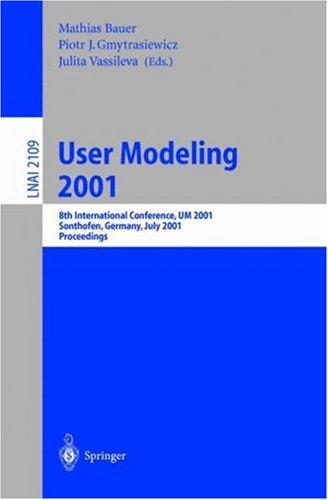
User modeling 2001

User modeling 2001

by International Conference on User Modeling (8th 2001 Sonthofen

Part of Lecture notes in computer science -- 2109. Lecture notes in artificial intelligence.

2001

Browse books you can read free on Readfeed

No club is reading this yet — be the first to start one

Start a club free
About
The study of the ?eld of user modeling (UM) has resulted in signi?cant amounts of theoretical work, as well as practical experience, in developing UM-based applications in traditional areas of human-computer interaction and tutoring systems. Further, it promises to have an enormous impact on recent developments in areas like information ?ltering, e-commerce, adaptive presentation techniques, and interface agents. A user model is an explicit representation of properties of a particular user, which allows the system to adapt diverse aspects of its performance to individual users’needs. TechniquesforUMhavebeendevelopedandevaluatedbytheoreticiansandpractitioners in a variety of ?elds, including arti?cial intelligence, education, psychology, cognitive science, linguistics, and human-computer interaction. The International Conferences on User Modeling constitute the major forum for pres- tationanddiscussionofboththelatestdevelopmentsinacademicresearchonallaspects of user modeling and industrial experience in deploying adaptive systems in real-world applications. This volume contains the proceedings of the Eighth International C- ference on User Modeling (UM2001), held in Sonthofen, Germany. It follows UM99 (Banff,Canada),UM97(Sardinia,Italy),UM96(Hawaii,USA),UM94(Hyannis,USA), UM92(Dagstuhl,WestGermany),UM90(Hawaii,USA)andUM86(MariaLaach,West Germany). Until now, the proceedings of the conference have been published with university p- lishers.AfterdiscussionswithinUMInc.,itwasdecidedfromnowontopublishthep- ceedingsvolumewithoneofthemajorpublishingcompanies,toensurewideravailability of the volume in libraries and archives. After careful consideration Springer-Verlag was chosen. The UM2001 program includes tutorials, invited talks, technical paper and poster s- sions, a doctoral consortium, workshops, and system demonstrations. There were a total of 79 technical submissions from 20 countries.

Discuss User modeling 2001 with other readers

Join or start a book club for User modeling 2001 on Readfeed. Live chat, shared reading progress, and AI discussion questions — free to get started.

Frequently asked questions

How do I join a book club for User modeling 2001?

Sign up free on Readfeed, then browse public clubs or start your own club with User modeling 2001 as the current read. Invite friends with a share link and discuss together with live chat and AI discussion questions.

Can I discuss User modeling 2001 with other readers online?

Yes. Readfeed book clubs let you chat live, share progress, and join discussions about User modeling 2001 with readers worldwide — whether your club is virtual, in-person, or hybrid.

Is Readfeed free?

Yes. Creating an account and joining book clubs is free. Sign up to find readers who love the same books and start discussing today.