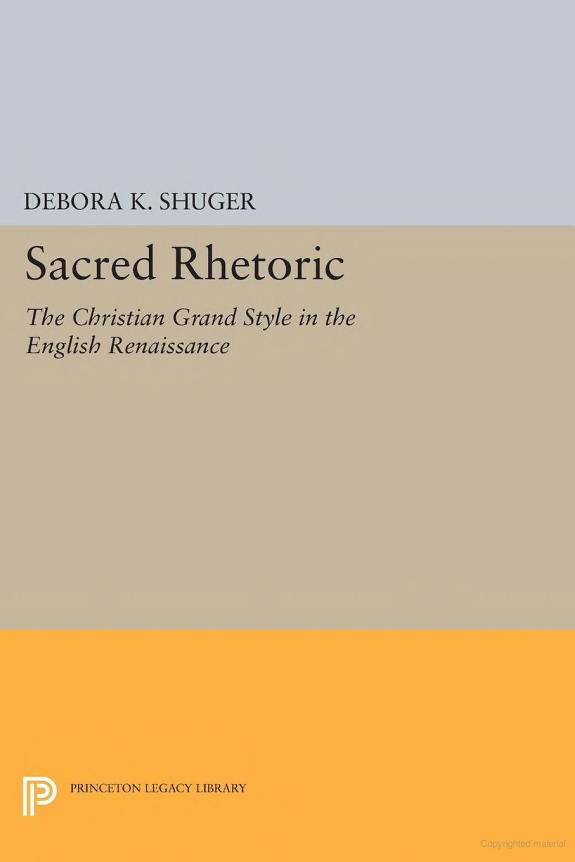
Sacred Rhetoric

Sacred Rhetoric

The Christian Grand Style in the English Renaissance

by Debora K. Shuger

302 pages· 2014· ISBN 9781400859269

Browse books you can read free on Readfeed

No club is reading this yet — be the first to start one

Start a club free
About
"There are no studies of a sacred grand style in the English Renaissance," writes Debora Shuger, "because even according to its practitioners it was not supposed to exist." Yet the grand style forms the unacknowledged center of traditional rhetorical theory. In this first history of the grand style, Professor Shuger explores the growth of a Christian aesthetic out of the Classical grand style, showing its development from Isocrates to the sacred rhetorics of the Renaissance. These rhetorics advocate a Christian grand style neither pedantically mimetic nor playfully sophistic, whose models include Tacitus and the Bible, as well as Cicero, and whose theoretical sources embrace not only Cicero and Quintilian, but Hermogenes and Longinus. This style dominates the best and most scholarly rhetorics of the period--texts written in Latin and, while ignored by most recent scholars, extensively used in England throughout the sixteenth and seventeenth centuries. These works are the first attempts since Augustine's pioneering revision of Ciceronian rhetoric to reground ancient rhetorical theory on Christian epistemology and theology. According to Professor Shuger, the Christian grand style is passionate, vivid, dramatic, metaphoric--yet this emotional energy and sensuousness is shaped and legitimated by Renaissance religious culture. Thus sacred rhetoric cannot be considered apart from contemporary theories of cognition, emotion, selfhood, and signification. It mediates between word and world. Moreover, these texts suggest the almost forgotten centrality of neo-Latin scholarship during these years and provide a crucial theoretical context for England's great flowering of devotional prose and poetry. Originally published in 1988. The Princeton Legacy Library uses the latest print-on-demand technology to again make available previously out-of-print books from the distinguished backlist of Princeton University Press. These paperback editions preserve the original texts of these important books while presenting them in durable paperback editions. The goal of the Princeton Legacy Library is to vastly increase access to the rich scholarly heritage found in the thousands of books published by Princeton University Press since its founding in 1905.

Discuss Sacred Rhetoric with other readers

Join or start a book club for Sacred Rhetoric on Readfeed. Live chat, shared reading progress, and AI discussion questions — free to get started.

Frequently asked questions

How do I join a book club for Sacred Rhetoric?

Sign up free on Readfeed, then browse public clubs or start your own club with Sacred Rhetoric as the current read. Invite friends with a share link and discuss together with live chat and AI discussion questions.

Can I discuss Sacred Rhetoric with other readers online?

Yes. Readfeed book clubs let you chat live, share progress, and join discussions about Sacred Rhetoric with readers worldwide — whether your club is virtual, in-person, or hybrid.

Is Readfeed free?

Yes. Creating an account and joining book clubs is free. Sign up to find readers who love the same books and start discussing today.