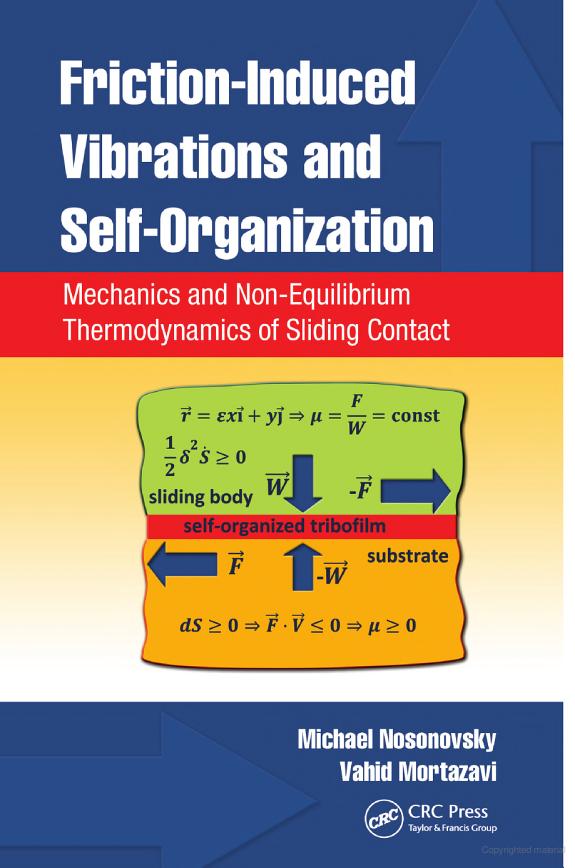
Friction-Induced Vibrations and Self-Organization

Friction-Induced Vibrations and Self-Organization

Mechanics and Non-Equilibrium Thermodynamics of Sliding Contact

by Michael Nosonovsky, Vahid Mortazavi

333 pages· 2013· ISBN 9781466504042

Browse books you can read free on Readfeed

No club is reading this yet — be the first to start one

Start a club free
About
Many scientists and engineers do not realize that, under certain conditions, friction can lead to the formation of new structures at the interface, including in situ tribofilms and various patterns. In turn, these structures—usually formed by destabilization of the stationary sliding regime—can lead to the reduction of friction and wear. Friction-Induced Vibrations and Self-Organization: Mechanics and Non-Equilibrium Thermodynamics of Sliding Contact combines the mechanical and thermodynamic methods in tribology, thus extending the field of mechanical friction-induced vibrations to non-mechanical instabilities and self-organization processes at the frictional interface. The book also relates friction-induced self-organization to novel biomimetic materials, such as self-lubricating, self-cleaning, and self-healing materials. Explore Friction from a Different Angle—as a Fundamental Force of Nature The book begins with an exploration of friction as a fundamental force of nature throughout the history of science. It then introduces general concepts related to vibrations, instabilities, and self-organization in the bulk of materials and at the interface. After presenting the principles of non-equilibrium thermodynamics as they apply to the interface, the book formulates the laws of friction and highlights important implications. The authors also analyze wear and lubrication. They then turn their attention to various types of friction-induced vibration, and practical situations and applications where these vibrations are important. The final chapters consider various types of friction-induced self-organization and how these effects can be used for novel self-lubricating, self-cleaning, and self-healing materials. From Frictional Instabilities to Friction-Induced Self-Organization Drawing on the authors’ original research, this book presents a new, twenty-first century perspective on friction and tribology. It shows how friction-induced instabilities and vibrations can lead to self-organized structures, and how understanding the structure–property relationships that lead to self-organization is key to designing "smart" biomimetic materials.

Discuss Friction-Induced Vibrations and Self-Organization with other readers

Join or start a book club for Friction-Induced Vibrations and Self-Organization on Readfeed. Live chat, shared reading progress, and AI discussion questions — free to get started.

Frequently asked questions

How do I join a book club for Friction-Induced Vibrations and Self-Organization?

Sign up free on Readfeed, then browse public clubs or start your own club with Friction-Induced Vibrations and Self-Organization as the current read. Invite friends with a share link and discuss together with live chat and AI discussion questions.

Can I discuss Friction-Induced Vibrations and Self-Organization with other readers online?

Yes. Readfeed book clubs let you chat live, share progress, and join discussions about Friction-Induced Vibrations and Self-Organization with readers worldwide — whether your club is virtual, in-person, or hybrid.

Is Readfeed free?

Yes. Creating an account and joining book clubs is free. Sign up to find readers who love the same books and start discussing today.