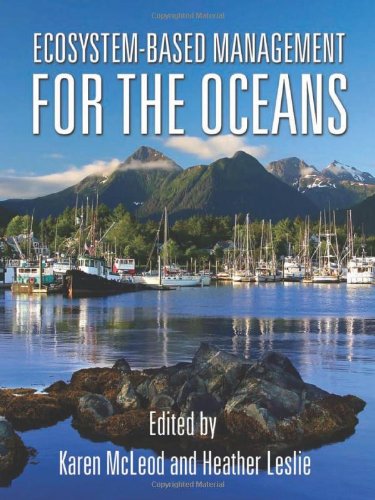
Ecosystem-Based Management for the Oceans
by Edward B. Barbier, Kathleen Dean Moore, James Boyd, Exequiel Ezcurra, Karen McLeod, Heather Leslie, Marco (Octavio) Aburto, Lilian (Naia) Alessa, Maria de los Angeles Carvajal, Brad Barr, Donald F. Boesch, Larry B. Crowder, Richard Cudney-Bueno, Tim Essington, Steve Ganey, Erica Goldman, Fred Guichard, Elliott Hazen, Kimberly Heiman, Leah Bunce Karrer, Les Kaufman, Ilse Kiessling, Ann Kinzig, Andrew (Anaru) Kliskey, Phil Levin, Jane Lubchenco, Don Maruska, Charlotte B. Mogensen, Maggie Mooney-Seus, Robert O'Boyle, Jonathan Peacey, Linwood Pendleton, Charles H. Peterson, Garry Peterson, Andrew A. Rosenberg, Mary Ruckelshaus, Roly Russell, Paul Sandifer, Janis Searles, Janna Shackeroff, Jorge Torre, Lisa Wainger, Dean Wendt, Tana Worcester
No club is reading this yet — be the first to start one
At its core, ecosystem-based management (EBM) is about acknowledging connections. Instead of focusing on the impacts of single activities on the delivery of individual ecosystem services, EBM focuses on the array of services that we receive from marine systems, the interactive and cumulative effects of multiple human activities on these coupled ecological and social systems, and the importance of working towards common goals across sectors. Ecosystem-Based Management for the Oceans provides a conceptual framework for students and professionals who want to understand and utilize this powerful approach. And it employs case studies that draw on the experiences of EBM practitioners to demonstrate how EBM principles can be applied to real-world problems.
The book emphasizes the importance of understanding the factors that contribute to social and ecological resilience —the extent to which a system can maintain its structure, function, and identity in the face of disturbance. Utilizing the resilience framework, professionals can better predict how systems will respond to a variety of disturbances, as well as to a range of management alternatives. Ecosystem-Based Management for the Oceans presents the latest science of resilience, while it provides tools for the design and implementation of responsive EBM solutions.
Discuss Ecosystem-Based Management for the Oceans with other readers
Join or start a book club for Ecosystem-Based Management for the Oceans on Readfeed. Live chat, shared reading progress, and AI discussion questions — free to get started.
Frequently asked questions
How do I join a book club for Ecosystem-Based Management for the Oceans?
Sign up free on Readfeed, then browse public clubs or start your own club with Ecosystem-Based Management for the Oceans as the current read. Invite friends with a share link and discuss together with live chat and AI discussion questions.
Can I discuss Ecosystem-Based Management for the Oceans with other readers online?
Yes. Readfeed book clubs let you chat live, share progress, and join discussions about Ecosystem-Based Management for the Oceans with readers worldwide — whether your club is virtual, in-person, or hybrid.
Is Readfeed free?
Yes. Creating an account and joining book clubs is free. Sign up to find readers who love the same books and start discussing today.