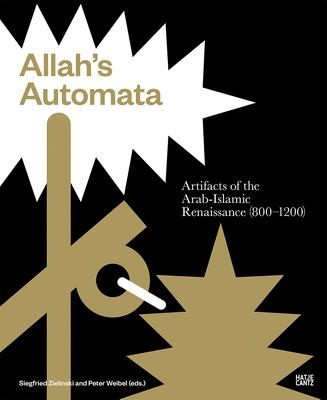
"The first Renaissance did not take place in Europe, but in Mesopotamia: Arabic-Islamic culture functioned as a mediator between classical antiquity and the early modern age in Europe. This volume, edited by renowned theorist Siegfried Zielinski, explores the rich and fascinating world of the automata that were developed and built during the golden age of the Arabic-Islamic cultures, the period from the early 9th to the 13th century. These machines, built to glorify God, draw mainly on the traditions of Greek Alexandria and Byzantium. They introduced spectacular innovations, which did not emerge in Europe until the modern era: permanent energy supply, universalism and programmability. Additionally, four of the master manuscripts of automata construction from Baghdad, Kurdistan and Andalusia are presented here: the Kitab ait Hiyal (Book of Ingenious Devices, circa 850 AD) by Banu Musa Ibn-akir; the Kitab al-urghanun (Book of the Organ, from the same period), a precedent for all modern programmable music automata; the Kitab fi ma’rifat al-hiyal al-handasiyya (Compendium on the Theory and Practice of the Mechanical Arts, 1206 AD) by the Kurdish engineer Al-Jazari; and the Kitab al-Asrar fi Nataij al Afkar (Book of Secrets) by"--
"The first Renaissance did not take place in Europe, but in Mesopotamia. In terms of the archaeology of media, the Arab-Islamic culture of knowledge and the related art of engineering essentially interposed between antiquity and the early modern period in Europe. Accompanying the exhibition of the same name at ZKM | Karlsruhe, this publication contains essays, documents, and illustrations that illuminate in an exemplary way the fascinating world of automata developed and built during the Golden Age of Arab-Islamic culture between the ninth and thirteenth centuries. The main focus is on four manuscripts by master designers and builders of automata from Baghdad, northern Mesopotamia, and Andalusia. The machines constructed and described by the “sons of Mūsā,” the Banū Mūsā ibn Shākir, and also by Ibn al-Razzāz al-Jazarī, Ibn Khalaf al-Murādī, and Abū Ḥātim al-Muẓaffar al-Isfizārī in praise of God the Almighty are primarily indebted to the Greco-Alexandrian and Byzantine traditions, and interwoven with aspects of the ancient Chinese, Indian, and Persian cultures. These machines incorporate spectacular innovations that in Europe are associated with modern times: permanent energy supply, motion, programmability, and universalism."--
"Centuries before the first automata caused a sensation in Europe, their technology had been developed in Arabic-Islamic cultures: as early as between the ninth and thirteenth centuries, Arabic scholars noted down their knowledge about machines, which they had acquired through the translation and further development of antique texts, in praise of God Almighty. The opulent publication introduces four master manuscripts on the construction of automata: two works by the Banu Musa Ibn-Šhakir from the mid-ninth century, one by the engineer Ibn al-Razzaz al-Jazari written in around 1200, as well as a manuscript by the Andalusian engineer Ahmad ibn Khalaf al-Muradi from the eleventh century. Accompanying essays reconstruct the development of the Muslim automata from the traditions of Alexandria, Rome, or Byzantium from a media-archeological perspective and throw light on their advancement in Europe."--