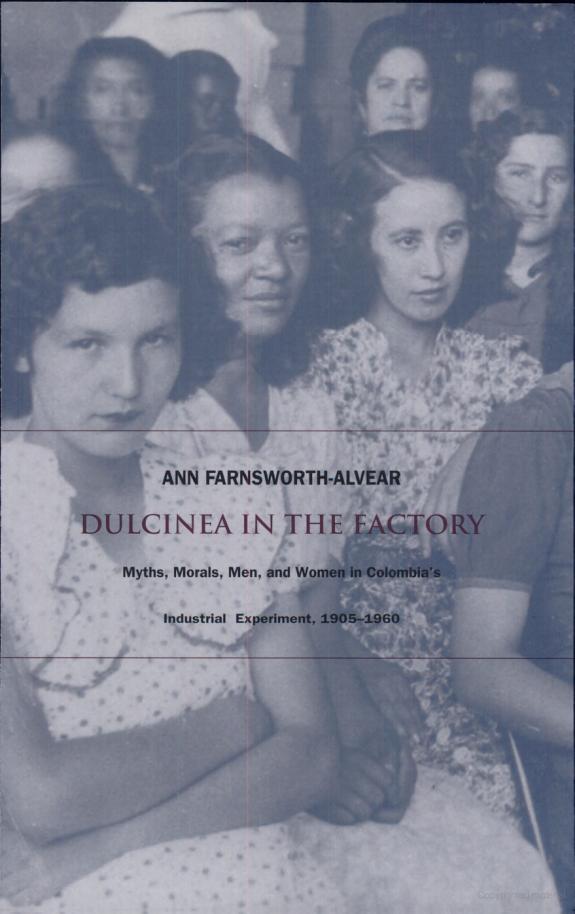
Dulcinea in the Factory

Dulcinea in the Factory

Myths, Morals, Men, and Women in Colombia’s Industrial Experiment, 1905–1960

by Ann Farnsworth-Alvear

303 pages· 2000· ISBN 9780822324973

Browse books you can read free on Readfeed

About
Before it became the center of Latin American drug trafficking, the Colombian city of Medellín was famous as a success story of industrialization, a place where protectionist tariffs had created a “capitalist paradise.” By the 1960s, the city’s textile industrialists were presenting themselves as the architects of a social stability that rested on Catholic piety and strict sexual norms. Dulcinea in the Factory explores the boundaries of this paternalistic order by investigating workers’ strategies of conformity and resistance and by tracing the disciplinary practices of managers during the period from the turn of the century to a massive reorganization of the mills in the late 1950s. Ann Farnsworth-Alvear’s analyses of archived personnel records, internal factory correspondence, printed regulations, and company magazines are combined with illuminating interviews with retired workers to allow a detailed reconstruction of the world behind the mill gate. In a place where the distinction between virgins and nonvirgins organized the labor market for women, the distance between chaste and unchaste behavior underlay a moral code that shaped working women’s self-perceptions. Farnsworth-Alvear challenges the reader to understand gender not as an opposition between female and male but rather as a normative field, marked by “proper” and “improper” ways of being female or male. Disputing the idea that the shift in the mills’ workforce over several decades from mainly women to almost exclusively men was based solely on economic factors, the author shows how gender and class, as social practices, converged to shape industrial development itself. Innovative in its creative employment of subtle and complex material, Dulcinea in the Factory addresses long-standing debates within labor history about proletarianization and work culture. This book’s focus on Colombia will make it valuable to Latin Americanists, but it will also appeal to a wide readership beyond Latin American and labor studies, including historians and sociologists, as well as students of women’s studies, social movements, and anthropology.

Discuss Dulcinea in the Factory with other readers

Join or start a book club for Dulcinea in the Factory on Readfeed. Live chat, shared reading progress, and AI discussion questions — free to get started.

Frequently asked questions

How do I join a book club for Dulcinea in the Factory?

Sign up free on Readfeed, then browse public clubs or start your own club with Dulcinea in the Factory as the current read. Invite friends with a share link and discuss together with live chat and AI discussion questions.

Can I discuss Dulcinea in the Factory with other readers online?

Yes. Readfeed book clubs let you chat live, share progress, and join discussions about Dulcinea in the Factory with readers worldwide — whether your club is virtual, in-person, or hybrid.

Is Readfeed free?

Yes. Creating an account and joining book clubs is free. Sign up to find readers who love the same books and start discussing today.