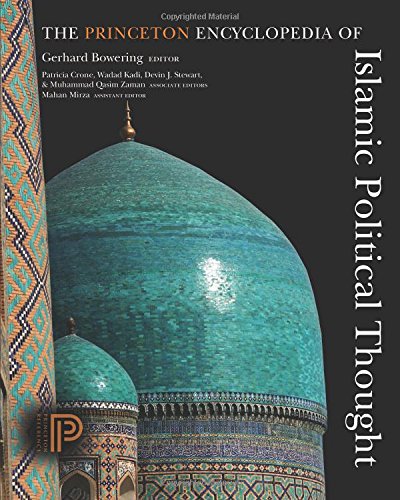
The Princeton Encyclopedia of Islamic Political Thought
by David Cook, Patricia Crone, Khaled Fahmy, Richard Bulliet, Ebrahim Moosa, Gerhard Böwering, Timur Kuran, Robert W. Hefner, Muhammad Qasim Zaman, Frank Griffel, Gerhard Bowering, Wadad Kadi, Devin J. Stewart, Mahan Mirza, Roxanne L. Euben, Bernard Haykel, Jane McAuliffe
No club is reading this yet — be the first to start one
The first encyclopedia of Islamic political thought from the birth of Islam to today, this comprehensive, authoritative, and accessible reference provides the context needed for understanding contemporary politics in the Islamic world and beyond. With more than 400 alphabetically arranged entries written by an international team of specialists, the volume focuses on the origins and evolution of Islamic political ideas and related subjects, covering central terms, concepts, personalities, movements, places, and schools of thought across Islamic history. Fifteen major entries provide a synthetic treatment of key topics, such as Muhammad, jihad, authority, gender, culture, minorities, fundamentalism, and pluralism. Incorporating the latest scholarship, this is an indispensable resource for students, researchers, journalists, and anyone else seeking an informed perspective on the complex intersection of Islam and politics.
- Includes more than 400 concise, alphabetically arranged entries
- Features 15 in-depth entries on key topics
- Covers topics such as:
Central themes and sources of Islamic political thought: caliph, modernity, knowledge, shari'a, government, revival and reform
Modern concepts, institutions, movements, and parties: civil society, Islamization, secularism, veil, Muslim Brotherhood
Islamic law and traditional Islamic societies: justice, taxation, fatwa, dissent, governance, piety and asceticism, trade and commerce
Sects, schools, regions, and dynasties: Mu'tazilis, Shi'ism, Quraysh, Mecca and Medina, Baghdad, Indonesia, Nigeria, Central Asia, Ottomans
Thinkers, personalities, and statesmen: Mawardi, Shafi'I, Saladin, Tamerlane, Akbar, Atatürk, Nasser, Khomeini
- Contains seven historical and contemporary maps of Muslim empires, postcolonial nation-states, populations, and settlements
- Guides readers to further research through bibliographies, cross-references, and an index
Discuss The Princeton Encyclopedia of Islamic Political Thought with other readers
Join or start a book club for The Princeton Encyclopedia of Islamic Political Thought on Readfeed. Live chat, shared reading progress, and AI discussion questions — free to get started.
Frequently asked questions
How do I join a book club for The Princeton Encyclopedia of Islamic Political Thought?
Sign up free on Readfeed, then browse public clubs or start your own club with The Princeton Encyclopedia of Islamic Political Thought as the current read. Invite friends with a share link and discuss together with live chat and AI discussion questions.
Can I discuss The Princeton Encyclopedia of Islamic Political Thought with other readers online?
Yes. Readfeed book clubs let you chat live, share progress, and join discussions about The Princeton Encyclopedia of Islamic Political Thought with readers worldwide — whether your club is virtual, in-person, or hybrid.
Is Readfeed free?
Yes. Creating an account and joining book clubs is free. Sign up to find readers who love the same books and start discussing today.