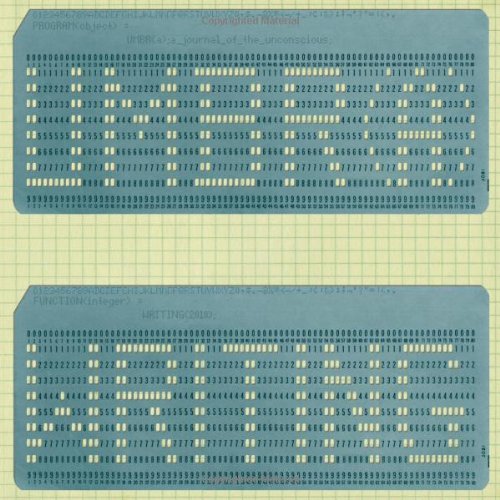
Umbr(a): Writing
by Jean-Michel Rabaté, Catherine Malabou, Pierre Klossowski, Tracy McNulty, Catherine Millot, Alenka Zupancic, Lucie Cantin, Sigi Jöttkandt
No club is reading this yet — be the first to start one
Indeed, if there is anything that makes psychoanalysis today uniquely situated to approach the question of writing it is the way in which it inherits -- in a structurally irrevocable way -- the distinction between speech and writing. Writing has been fundamentally, but almost paradoxically, implicated in psychoanalysis from the very outset. Freud became convinced of the existence of the unconscious through direct and repeated experience of its manifestations in the speech and acts of his analysands. However, in order for his singular discovery to be useful and convincing to others who had not had the benefit of direct experience he was compelled to write. This point cannot be emphasized enough: Psychoanalysis, as it exists today, is a direct consequence of the manner in which Freud translated and transmitted his clinical experience through the fundamentally incompatible register of writing. In his case histories, for example, Freud makes it abundantly clear that what he has written is by no means a wholly accurate or linear representation of the course of the analysis in question. What the reader experiences will not be identical to what Freud experienced. Yet Freud nevertheless writes with the expectation of producing the same effect in his reader: a repetition of his inaugural experience of the unconscious. As readers of Freud, we inherit a very specific relation to repetition, and that repetition cannot be unbound from the writing of which it is a consequence. In this sense, Freud's writing has served, and continues to serve, as the base case for a peculiar sort of mathematical induction. Every reader must repeat the discovery of the unconscious and reinvent psychoanalysis, as if for the first time, while being constrained by nothing but the economy of Freud's writing. This is the Freudian wager: that the psychoanalysis we invent by reading what he has written will be, somehow, the same psychoanalysis.
Discuss Umbr(a): Writing with other readers
Join or start a book club for Umbr(a): Writing on Readfeed. Live chat, shared reading progress, and AI discussion questions — free to get started.
Frequently asked questions
How do I join a book club for Umbr(a): Writing?
Sign up free on Readfeed, then browse public clubs or start your own club with Umbr(a): Writing as the current read. Invite friends with a share link and discuss together with live chat and AI discussion questions.
Can I discuss Umbr(a): Writing with other readers online?
Yes. Readfeed book clubs let you chat live, share progress, and join discussions about Umbr(a): Writing with readers worldwide — whether your club is virtual, in-person, or hybrid.
Is Readfeed free?
Yes. Creating an account and joining book clubs is free. Sign up to find readers who love the same books and start discussing today.