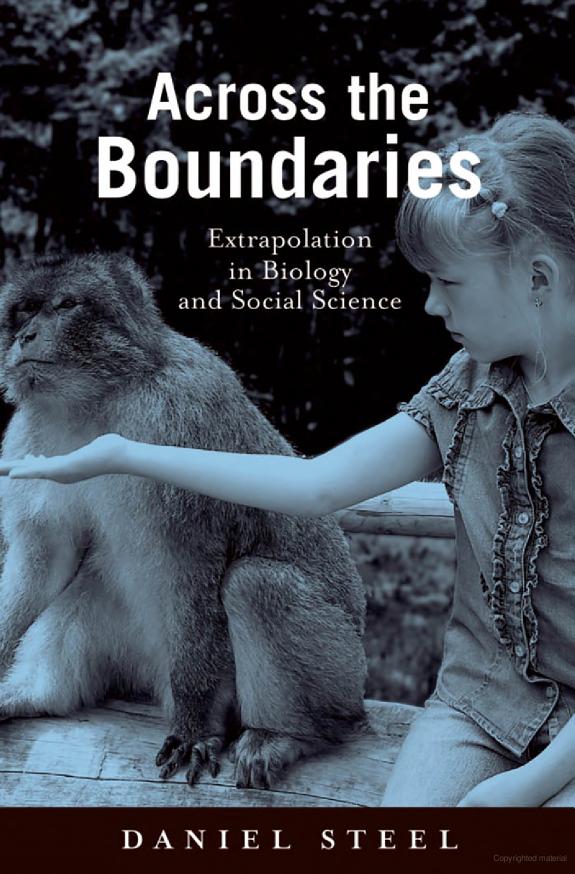
Across the Boundaries

Across the Boundaries

Extrapolation in Biology and Social Science

by Daniel Steel

256 pages· 2007· ISBN 9780198044147

Browse books you can read free on Readfeed

No club is reading this yet — be the first to start one

Start a club free
About
The biological and social sciences often generalize causal conclusions from one context or location to others that may differ in some relevant respects, as is illustrated by inferences from animal models to humans or from a pilot study to a broader population. Inferences like these are known as extrapolations. The question of how and when extrapolation can be legitimate is a fundamental issue for the biological and social sciences that has not received the attention it deserves. In Across the Boundaries, Steel argues that previous accounts of extrapolation are inadequate and proposes a better approach that is able to answer methodological critiques of extrapolation from animal models to humans. Across the Boundaries develops the thought that knowledge of mechanisms linking cause to effect can serve as a basis for extrapolation. Despite its intuitive appeal, this idea faces several obstacles. Extrapolation is worthwhile only when there are stringent practical or ethical limitations on what can be learned about the target (say, human) population by studying it directly. Meanwhile, the mechanisms approach rests on the idea that extrapolation is justified when mechanisms are the same or similar enough. Yet since mechanisms may differ significantly between model and target, it needs to be explained how the suitability of the model could be established given only very limited information about the target. Moreover, since model and target are rarely alike in all relevant respects, an adequate account of extrapolation must also explain how extrapolation can be legitimate even when some causally relevant differences are present. Steel explains how his proposal can answer these challenges, illustrates his account with a detailed biological case study, and explores its implications for such traditional philosophy of science topics ceteris paribus laws and reductionism. Finally, he considers whether mechanisms-based extrapolation can work in social science.

Discuss Across the Boundaries with other readers

Join or start a book club for Across the Boundaries on Readfeed. Live chat, shared reading progress, and AI discussion questions — free to get started.

Frequently asked questions

How do I join a book club for Across the Boundaries?

Sign up free on Readfeed, then browse public clubs or start your own club with Across the Boundaries as the current read. Invite friends with a share link and discuss together with live chat and AI discussion questions.

Can I discuss Across the Boundaries with other readers online?

Yes. Readfeed book clubs let you chat live, share progress, and join discussions about Across the Boundaries with readers worldwide — whether your club is virtual, in-person, or hybrid.

Is Readfeed free?

Yes. Creating an account and joining book clubs is free. Sign up to find readers who love the same books and start discussing today.