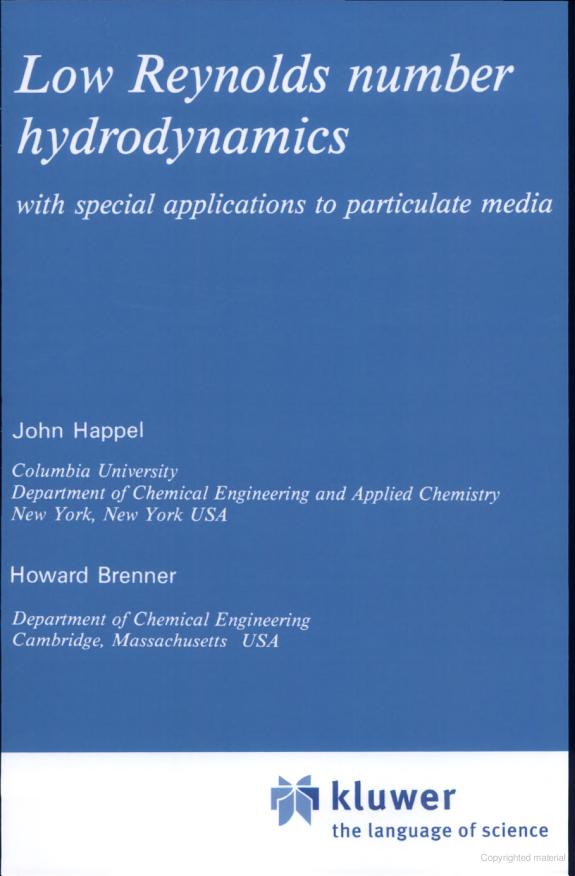
Low Reynolds number hydrodynamics

Low Reynolds number hydrodynamics

with special applications to particulate media

by J. Happel, H. Brenner

553 pages· 1983· ISBN 9789024728770
About
One studying the motion of fluids relative to particulate systems is soon impressed by the dichotomy which exists between books covering theoretical and practical aspects. Classical hydrodynamics is largely concerned with perfect fluids which unfortunately exert no forces on the particles past which they move. Practical approaches to subjects like fluidization, sedimentation, and flow through porous media abound in much useful but uncorrelated empirical information. The present book represents an attempt to bridge this gap by providing at least the beginnings of a rational approach to fluid particle dynamics, based on first principles. From the pedagogic viewpoint it seems worthwhile to show that the Navier-Stokes equations, which form the basis of all systematic texts, can be employed for useful practical applications beyond the elementary problems of laminar flow in pipes and Stokes law for the motion of a single particle. Although a suspension may often be viewed as a continuum for practical purposes, it really consists of a discrete collection of particles immersed in an essentially continuous fluid. Consideration of the actual detailed boundary value problems posed by this viewpoint may serve to call attention to the limitation of idealizations which apply to the overall transport properties of a mixture of fluid and solid particles.

Discuss Low Reynolds number hydrodynamics with other readers

Join or start a book club for Low Reynolds number hydrodynamics on Readfeed. Live chat, shared reading progress, and AI discussion questions — free to get started.

Frequently asked questions

How do I join a book club for Low Reynolds number hydrodynamics?

Sign up free on Readfeed, then browse public clubs or start your own club with Low Reynolds number hydrodynamics as the current read. Invite friends with a share link and discuss together with live chat and AI discussion questions.

Can I discuss Low Reynolds number hydrodynamics with other readers online?

Yes. Readfeed book clubs let you chat live, share progress, and join discussions about Low Reynolds number hydrodynamics with readers worldwide — whether your club is virtual, in-person, or hybrid.

Is Readfeed free?

Yes. Creating an account and joining book clubs is free. Sign up to find readers who love the same books and start discussing today.