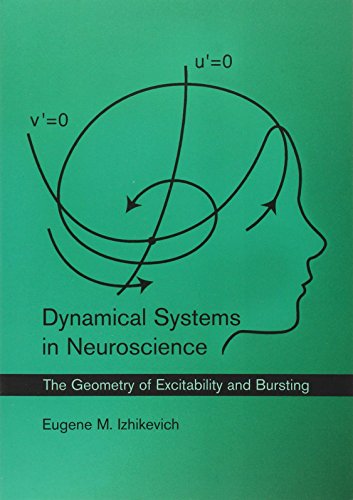
Dynamical Systems in Neuroscience: The Geometry of Excitability and Bursting (Computational Neuroscience Series)
by Eugene M. Izhikevich
No club is reading this yet — be the first to start one
1 reader has this book on their Readfeed shelves
In order to model neuronal behavior or to interpret the results of modeling studies, neuroscientists must call upon methods of nonlinear dynamics. This book offers an introduction to nonlinear dynamical systems theory for researchers and graduate students in neuroscience. It also provides an overview of neuroscience for mathematicians who want to learn the basic facts of electrophysiology.
Dynamical Systems in Neuroscience presents a systematic study of the relationship of electrophysiology, nonlinear dynamics, and computational properties of neurons. It emphasizes that information processing in the brain depends not only on the electrophysiological properties of neurons but also on their dynamical properties. The book introduces dynamical systems, starting with one- and two-dimensional Hodgkin-Huxley-type models and continuing to a description of bursting systems. Each chapter proceeds from the simple to the complex, and provides sample problems at the end. The book explains all necessary mathematical concepts using geometrical intuition; it includes many figures and few equations, making it especially suitable for non-mathematicians. Each concept is presented in terms of both neuroscience and mathematics, providing a link between the two disciplines.
Nonlinear dynamical systems theory is at the core of computational neuroscience research, but it is not a standard part of the graduate neuroscience curriculum -- or taught by math or physics department in a way that is suitable for students of biology. This book offers neuroscience students and researchers a comprehensive account of concepts and methods increasingly used in computational neuroscience.
An additional chapter on synchronization, with more advanced material, can be found at the author's website, www.izhikevich.com.
Discuss Dynamical Systems in Neuroscience: The Geometry of Excitability and Bursting (Computational Neuroscience Series) with other readers
Join or start a book club for Dynamical Systems in Neuroscience: The Geometry of Excitability and Bursting (Computational Neuroscience Series) on Readfeed. Live chat, shared reading progress, and AI discussion questions — free to get started.
Frequently asked questions
How do I join a book club for Dynamical Systems in Neuroscience: The Geometry of Excitability and Bursting (Computational Neuroscience Series)?
Sign up free on Readfeed, then browse public clubs or start your own club with Dynamical Systems in Neuroscience: The Geometry of Excitability and Bursting (Computational Neuroscience Series) as the current read. Invite friends with a share link and discuss together with live chat and AI discussion questions.
Can I discuss Dynamical Systems in Neuroscience: The Geometry of Excitability and Bursting (Computational Neuroscience Series) with other readers online?
Yes. Readfeed book clubs let you chat live, share progress, and join discussions about Dynamical Systems in Neuroscience: The Geometry of Excitability and Bursting (Computational Neuroscience Series) with readers worldwide — whether your club is virtual, in-person, or hybrid.
Is Readfeed free?
Yes. Creating an account and joining book clubs is free. Sign up to find readers who love the same books and start discussing today.